
How long does it take to decolonise your mind? I’m not entirely sure if it takes years, decades or a lifetime. That said, the experience of moving from Scotland to live in a small independent nation, is perhaps an indicator?
Some of us now realise that Scotland was not only annexed and occupied, but colonised. That idea is, of course, mocked by some. And they do have a point. Under James VI – James I of England – our absent Scottish monarch focused on his union of the crowns. The pursuit of ‘Britishness’ and union flag was one of his foibles as King.
Only a few years after being crowned monarch of Scotland England and Ireland in 1603, the plantation of Ireland began. We’re informed that, “James, a Protestant, wanted to unite his three kingdoms and strengthen his rule in Ireland where he faced opposition and rebellion from the Catholic, Irish speaking population.”

His Britishness foible didn’t stop there. He wanted people from England and Scotland to move to the northern part of Ireland to make it friendlier towards his reign. Hence the ‘Plantation of Ulster’ by English and Scots speaking Protestants – ‘planters’.
“This was Scotland’s first, and ultimately most successful, project of colonisation beyond its shores.” The Plantation of Ulster (1610–1630) | Discover Ulster-Scots
But I digress. Scotland itself was captured in the trap of ‘union’ in 1707. However, it became clear, almost immediately, that our nation had become a vassal state. The English parliament continued, only its name changed – the parliament of Great Britain. Scottish popular rebellions were crushed, brutally, with the aid of 18th century ‘Yoons’ in red coats.
After 1746, our nation was annexed militarily by our neighbour, this was accompanied by an attempted ethnocide
Fast forward to 2024. Many of we Scots have inherited the legacy of poverty that comes with being a vassal state. This at the same time as Scots are still leaving in new clearances only to be replaced by wealthy ‘planters’ from south of the border. Economic migrants do not necessarily feel any sympathy with our Scottish culture or way of life. They arrive for their own sake. They arrive on a wave of Britishness. Indigenous members of local populations are priced out. Enclaves form, demographics change – and hey presto, London-based, unionist parties in Scotland have a whole new voter base. They even have the latest incarnation of the Haus Sachsen-Coburg und Gotha dynasty as monarch. He would no doubt affirm the imperial mindset that, ‘England ist England und Schottland ist England’.
Charles III of England isn’t, of course, ‘King of Scots’. He has not sworn the Scottish oath. That would be too awkward for him, because the entire theft of our territorial resources depends on the pretence that the Crown Estate of England extends to Scottish territory. He can wear all the kilts he likes but no amount of tartan accessorising gives him any authority over our sovereign people and, more importantly, our sovereign territory.
So how long does it take to decolonise your mind, once free? Does the metamorphosis from subject of a vassal state to citizen of an independent nation cover the span of a lifetime?
For my part, it didn’t take long for the benefits of small-nation independence to hit home. Even decades ago, Denmark was far ahead of Scotland on every practical level. Transport, housing, social care, education bursaries for all, all-round infrastructure, and general quality of life. It was a revelation to live among a people who knew who they were, who acknowledge their national identity so much that their flag has become a symbol of warmth and celebration rather than a mere national emblem. Realising that my adopted home was everything Scotland could be, but wasn’t, was painful to see on each return visit to the old country.

So many Scots are still blighted by poverty, a poverty caused by our nation being run as what Prof Alf Baird describes as an ‘extraction colony’.
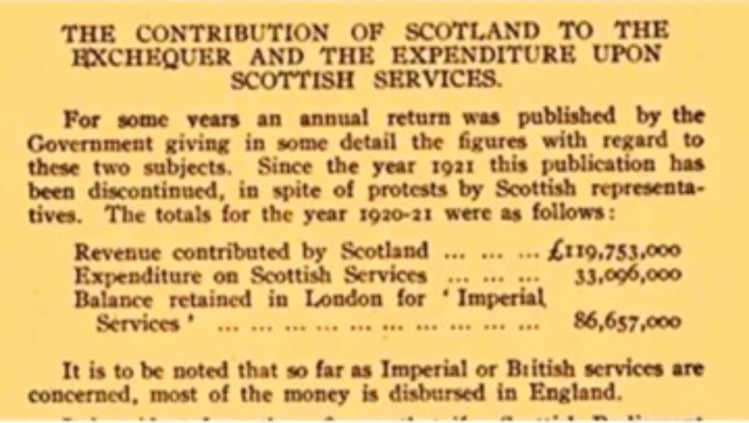
My parents who grew up in an era when 2/3 of Scottish revenues were spent in England. We know this because they kept publishing these figures until 1921.

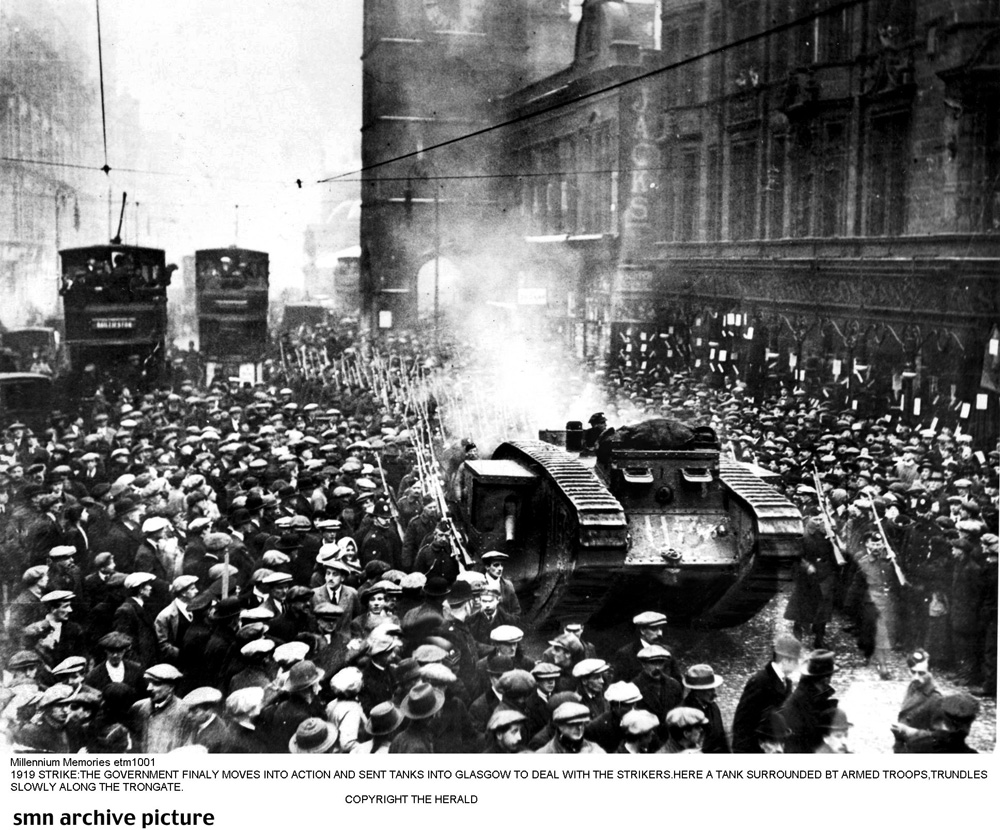
Ma ma was a days-auld bairn in Well Street, Calton, when the massive rally was held in George Square in 1919 – the revolutionary uprising that never was. It could all have been so different. The words of Kenny MacAskill:
“For some on the left, including Willie Gallacher, who was later to become a Communist MP, and was downed by a baton in George Square that day as well as imprisoned for his troubles, there was regret that a revolutionary moment had been missed. He rued that strikers hadn’t marched to Maryhill Barracks, the city’s military garrison, to encourage local soldiers to come out and join them in their actions.”
Despite both parents being born at a time when the most tumultuous Scottish events of the 20th century were playing out in Glasgow, neither ever talked politics, or of the past. In my experience, politics is not something the poor think about very much. The sense of disempowerment that comes from being ‘out of the game’, financially and socially, makes politics irrelevant. Harry and Kathy, like many others from Toonheid and Calton, struggled to simply survive.
As for me, when I passed through the sandstone columns at the entrance to Glasgow Central in early September 1974, I’d no idea that I would never again live permanently in the city of my birth. But then again, there was nothing to return to. Years of permanent sofa surfing is no life. So exile was an easy choice, though not easy in practical terms.
Today, living in a nation where self-determination is the norm is inspiring on many levels. It’s also educational. There are aspects of Danish life we may, as Scots, wish to avoid. Its devotion to an ever-more dictatorial elite in Brussels and its servility to NATO is deeply perplexing. It would be better-served as a neutral country and member of EFTA, but a whole cadre of wannabe Brussels bureaucrats now see the EU as a hugely lucrative post-politics career. So don’t expect radical change any time soon.
Meanwhile, back in Glasgow, people still queue up at a soup kitchen under the ‘Hielanman’s Umbrella’ at Central Station. Precious city heritage – neglected for much of the 20th century by Labour’s be-suited apparatchiks – still has trees growing out of its crumbling elegance.
Neither of my parents healed from the scars of childhood and youth. There are personal details too sad to relate here. Suffice to say, I now understand why they were dysfunctional; why alcohol became a refuge for my father, and why my mother disappeared to a sister in England, never to return. She had suffered what we today call a mental breakdown.
Imagine if, in the first decades of the 20th century, the 2/3 of Scottish revenues withheld by London, had been spent in Scotland. Think if we had avoided the Armageddon of the Great War, just as Denmark did as an independent and neutral country. All of us born generations later would have inherited the legacy of independence, instead of an impoverished vassal state subject to English extractive colonialism. And a ‘Yes’ vote in 2014 would have meant we were 10 years into the metamorphosis of our colonised minds.
Several decades into my exile in Denmark, I’m well decolonised, mentally. That means seeing things as they are, from the distance of the miles.

First of all, our so-called nationalist politicians are career-loving con-artists. Where else could they earn the salaries they’re on at Westminster and Holyrood? Indy urgency died when they realised they could secure a fabulous life-changing income beyond their wildest dreams, not to mention their meagre abilities.
Secondly, Unionist parties in Scotland are ‘agents of foreign influence’. A type of political apparatchik viewed with suspicion in most normal countries. Scottish members of these parties are what Danes would call ‘landsforrædder’ – traitors. In any other country they would face criminal prosecution.
Thirdly, our neighbour, and so-called partner in union, is in a state of undeclared war on Scotland. Its information war, carried out through the state media, is aggressive and relentless. Scots are subject to industrial-scale brainwashing – and have been for centuries.
However, our neighbour is also engaged in economic warfare against our nation. Its latest manifestation is the closure of Grangemouth.
Then there’s the channelling of our own revenues through the Scotland Office (perhaps better termed the anti-Scotland Office) whose purpose is to sideline the existing excuse for a parliament. Once your de-colonised mind has seen it, you can’t unsee it.
At Holyrood 2026 we need a #LiberationAlliance of pro-indy parties and organisations. If we Scots want to give our children and our children’s children a better future we must abandon the traditional nationalist party. They are now as compromised and moribund as the Irish IPP party was back in 1918. They are good only for the dustbin of history.
“In the final analysis, we all breathe the same air, we are all mortal, and we all cherish our children’s future”.
 peteryoung.dk
Apologies for the typos in the original draft. Should be corrected now.
LikeLiked by 1 person
The oft published photograph of a tank rolling through Glasgow is actually one of a tank there for exhibition, much later than the speeches of rebellion. It’s used to give the impression of tanks rolling into Glasgow to quell an uprising, a myth, although Churchill had a few and a regiment standing by in case his plnated distrupters caused anything serious to the advantage of the British State..
LikeLike
Thanks Gareth.
LikeLiked by 1 person