Geneva speech by Ailsa Gray, BSc, LLB (Scots Law): Corporate lawyer / former Non-Executive Director of Highlands and Islands Enterprise
[Images added added by way of illustration]
Robert Black concluded that Scotland did not enter a voluntary partnership in 1707 but was annexed by a continuing English state – a corporate takeover in all but name. History establishes that this takeover was hostile.
Pre-union Pressures and Economic Sabotage
After the Union of the Crowns in 1603, James VI moved his court to London. Royal proclamations increasingly served English interests, eroding Scottish autonomy while preserving the illusion of shared sovereignty. Scotland was compelled to sever historic alliances with France and Holland, disrupting trade and deepening economic instability.
The Navigation Acts barred Scotland from trade and imposed tariffs on Scottish goods. The Darien Scheme, Scotland’s attempt to reclaim economic agency, was sabotaged by England, ultimately failing in 1700 and plunging Scotland into near bankruptcy. A crisis that became the fulcrum upon which the Union turned.
The Alien Act of 1705 threatened to treat Scots as foreigners and cut off trade unless they entered negotiations for a Union. Between 1706 and 1707, Scotland erupted in protest: over 80 formal petitions opposed the Union and riots broke out.
English warships in the Forth and troops at the border served to intimidate the Scots into signing the Articles of Union – or prepare for invasion. While this threat was later downplayed, the UK Parliament’s own history pages state that troops were brought into Edinburgh“with orders to shoot if necessary.”
Support for the Union was also secured through bribery and patronage – pensions, titles, and appointments were offered to sway votes. Robert Burns captured the public mood when he wrote:
“We’re bought and sold for English gold – Such a parcel of rogues in a nation.”
Daniel Defoe, was sent to Scotland and reportedly remarked:
“A Scots rabble is the worst of its kind … for every Scot in favour there is 99 against.”
The Treaty of Union was not a voluntary partnership. It was a hostile takeover – forged under economic duress, military threat, political coercion, and widespread public outrage. After the Treaty was signed, its foundational promises were quickly broken, laying the emotional groundwork for the risings of 1715, 1719, and 1745.
Annexation, not Union
Robert Black cited the naming of Queen Elizabeth II as evidence that the English monarchy and state continued unbroken. The House of Commons library supports this, stating that “the English Coronation Oath was extended to Scotland”. While the oath was amended to include a commitment to uphold the Presbyterian religion, it omitted an obligation to uphold the Claim of Right – a cornerstone of Scotland’s constitutional identity – and a pre-condition of the Union.
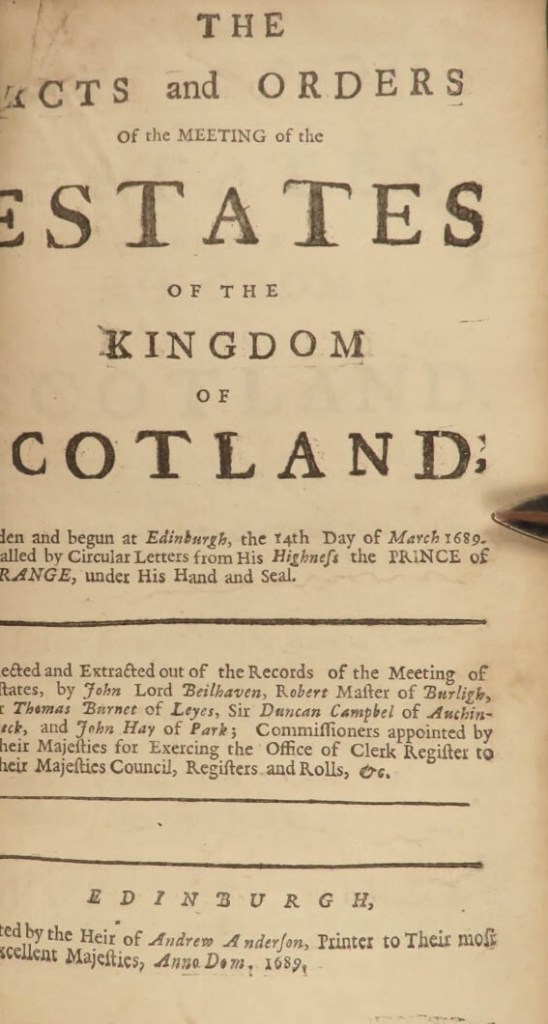
The Claim of Right Act 1689 reaffirmed that sovereignty belongs to the people – the Community of the Realm. Scotland’s monarchs’ rule with their consent, and in accordance with Scots law. That’s why Scotland has kings and queens of the Scots, not of Scotland.
This principle of conditional monarchy is rooted in the Declaration of Arbroath in 1320 and was upheld when James VII was removed from the Scottish throne for violating Scotland’s laws and liberties.
Despite the Claim of Right remaining a part of Scots law to this day, it was shelved – like many of the foundational articles of the Treaty of Union. Scottish Sovereignty – which still legally vests in the people – was assumed by an English monarchy and Parliament.
Partnership or Dependency
In the mid-20th century, amid global UN-led decolonisation, the Royal Commission on Scottish Affairs, chaired by Lord Balfour, was convened to review Scotland’s constitutional status. Balfour – a Scottish peer, English-born, Eton-educated, and nephew of a former Prime Minister – was a reassuring choice for the Anglo-British establishment.
Tasked with reinforcing the legitimacy of the Union – at a time when imperial structures were crumbling worldwide – his Commission concluded, Scotland was:
“… a nation [which] “entered the union as a voluntary partner and not as a dependency.”
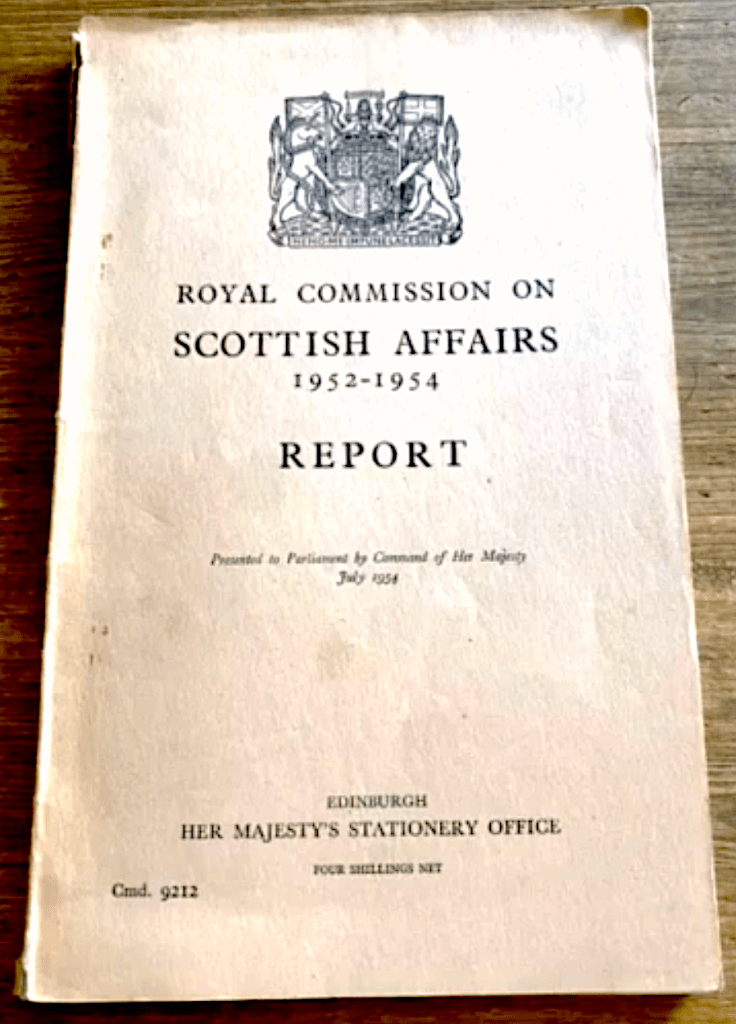
This framing that Scotland is a voluntary partner in a union and therefore not a dependency has been repeatedly invoked – and weaponised – by Westminster. Used to dismiss Scotland’s democratic calls for self-determination. Yet this positioning collapses under scrutiny.
The word “voluntary” is spurious given the noxious conditions under which the Treaty of Union was signed. But was it ever a partnership?
If Scotland entered a partnership, then the Treaty of Union was the partnership agreement. This agreement was never honoured:
- No new state was created
- No new coronation oath was established
- Scotland’s constitution and sovereignty were subordinated to English law
- Scotland’s resources administered without title or consent, and
- Its independent institutions abolished or absorbed.
These are not the hallmarks of a partnership – they are the structural features of annexation.
In 1707, there was no mutual agreement, no consensus in idem, to justify the unilateral actions taken by a continuing English state. It is specious to claim – then and now – that Scotland entered a partnership – voluntary or otherwise. What emerged was not a union, but the subordination of Scotland into a non-self-governing territory, administered by a dominant power masquerading as a constitutional union. This ancient state of Scotland remains a state in abeyance, awaiting restoration.
Accordingly, the contemporary accusation being levelled at Scotland, that Scotland was part of the Anglo-British colonial project is equally specious – an argument that Craig Murray eloquently made in yesterday’s “The National” newspaper.
In 1954, the language of “partnership” was deployed not to reflect reality, but to shield the UK from international scrutiny during the age of decolonisation.
And so, by inverting the logic of the Balfour Commission … if Scotland is not a voluntary partner, then it is a dependency, an annex of a continuing English state, cosmetically rebranded as “Great Britain.”
Scotland’s Crown and Territorial Sovereignty
Though Scotland ceased to exist as a separate state in the eyes of the international community, two crowns and two kingdoms remain. The Scottish Crown – vacant yet governed by Scots law – retains constitutional and territorial identity. Sovereignty over Scotland’s land, forests, seabed, foreshore, minerals, oil, aquaculture, and marine infrastructure – belongs to its people.
Yet for centuries, these assets were administered by Whitehall, with revenues flowing to the UK Treasury. Only recently has Crown Estate Scotland begun managing a portion of them. Scotland’s oil and gas, however, remain under the control of a rebranded English Crown, through legislation rooted in English constitutional principles.
Crown Estate Scotland’s accountability to the Scottish Government is constrained by the limited powers of devolution – powers which many argue reduce it to little more than a colonial administration. This reflects the asymmetry of dependency not a parity of partnership.
Until 1999, all ownerless property in Scotland – from heirless estates to dissolved companies – was claimed by the King’s and Lord Treasurer’s Remembrancer, with revenues transferred to London.
When North Sea oil and gas was discovered in Scottish waters in the 1970s,calls for a sovereign wealth fund – akin to Norway’s 1.5 trillion-dollar reserve – were ignored. Revenues were diverted to the UK Treasury, used to fund tax cuts, offset deficits, and privatise national assets.
I have a personal connection to this story. My father, also a lawyer, chaired Scotland’s economic development agency during this period. When he set up an oil club and proposed that Scotland benefit from its oil revenues, he was removed from office by Prime Minister Margaret Thatcher.
In 1999, on the eve of devolution, Prime Minister Tony Blair reassigned 6,000 square miles of resource-rich Scottish waters to English jurisdiction – without debate or consultation with the Scottish people.
In 2020, the UK Internal Market Act directly encroached upon Scottish Parliament’s devolved powers, seriously undermining Scotland’s capacity to shape its own economic landscape. The Act paved the way for Freeports – opaque, deregulated zones offering tax and customs exemptions – imposed without Scottish consent. The land and waters around the Forth and Moray Estuaries now stand open to exploitation by large multinational corporates – answerable to no one in Scotland.
These examples demonstrate that since 1707, Scotland’s considerable natural resources have been extracted to serve its coloniser, with little reinvestment in its own people.
The Rights That Remain
Despite centuries of subjugation, Scotland retains the enduring legal and territorial rights of a sovereign nation:
- The right to permanent sovereignty over natural resources
- The right to regain effective control over those resources, and
- The right to restitution and full compensation for extracted wealth.
Scotland entered a political and economic union – not a territorial one. Its constitutional and territorial identity remains distinct, yet its governance and sovereignty have been systematically absorbed by another state.
This is not partnership. This is dependency dressed in constitutional ceremony.
Two Scottish Advocates
History bears witness to the fact that this sleight of hand did not escape the notice of two discerning Scottish minds – Sir Walter Scott and Robert Louis Stevenson, both writers and Scottish lawyers.
Scott – initially pro-union – played a central role in welcoming King George IV to Scotland in 1822. Yet he grew alarmed at the erosion of Scots law and the rising number of appeals to English courts. In his journal, he prophetically warned:
“The consequence will in time be that the Scottish Supreme Court will be in effect situated in London. Then down fall – as national objects of respect and veneration – the Scottish bench – the Scottish Bar – the Scottish Law herself – And – And – there is an end of an auld Sang.”
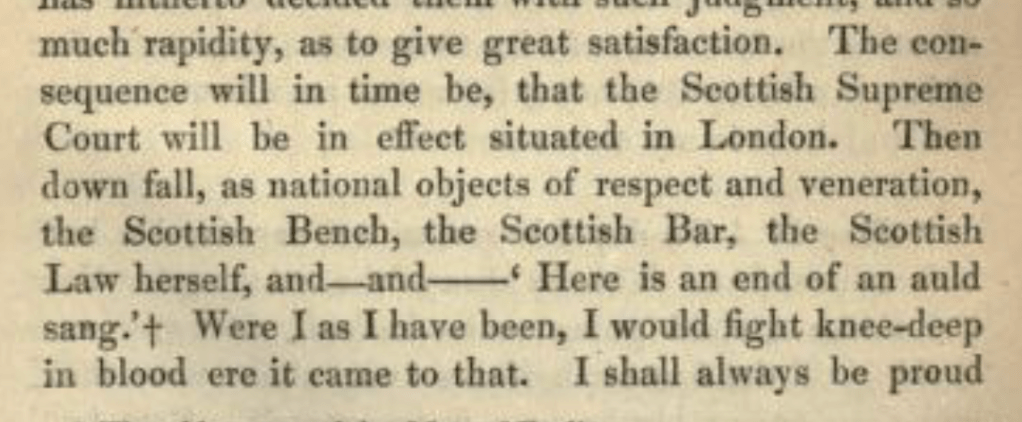
“End of an Auld sang” – is Scots for end of an old song – words first uttered by James Ogilvy, Earl of Seafield as he signed of the Act of Union. His words became a symbol of Scotland’s constitutional subordination and within five years, Seafield was among those calling for the Union to be reversed.
In the 1880’s Robert Louis Stevenson – also initially pro-union – planned to write a book on Scotland’s history. But after immersing himself in trial papers, and firsthand accounts, he abandoned the project. He used his research to write a historic-fiction book – part-written in Scots – called Kidnapped; set in the years following Culloden. Compelled to write this after he witnessed the evictions of Highland Scots in 1870, over a century after the Highland Clearances first began.
Beneath his Jacobite adventure story lies a forensic account of colonial violence: military occupation, the targeting of civilians, scorched earth tactics – crops razed, cattle seized, townships reduced to ash. Communities left to starve in a calculated act of attritional warfare. What followed was cultural erasure: the systematic dismantling of the clan structure, and the proscription of Gaelic language, religion, dress and music – each pillar of identity criminalised. People were forcibly cleared from their land – to make way first for sheep, then deer – then transported to the colonies on ‘coffin ships’, to toil as unpaid indentured labourers on cotton and tobacco plantations.
As Barry Menikoff, Professor of Literature at Hawaii University wrote:
Kidnapped was “anticolonialist document […] a statement on the power of art to reclaim the past and reconstitute its victims and its villains”. It was “an artist’s gift to the country of his birth and the language of his people.” “Stevenson created a social and political chronical without ever giving the impression of having done so”
Conclusion
I agree with Robert Burns, Sir Walter Scott, Robert Louis Stevenson and Robert Black: the Treaty of Union was not a partnership of equals. Instead, it was a hostile takeover – or annexation – by a continuing English state.
Scotland’s sovereignty was not extinguished – it was repackaged, redirected, and repressed. The Scottish Crown, the Claim of Right, and the Community of the Realm endure – not as relics, but as living constitutional truths. They remind us that sovereignty is not granted by Westminster, nor inherited by monarchs – it is vested in the people.
The old song did not end in 1707. It was silenced, distorted, and buried beneath ceremony – but never forgotten. It lives in the law, it lives in the land, and it lives in the hearts of those who believe that Scotland is not a possession to be administered, but a nation to be respected.
The question is not whether Scotland is a dependency. The real question is whether it will remain so.
 peteryoung.dk