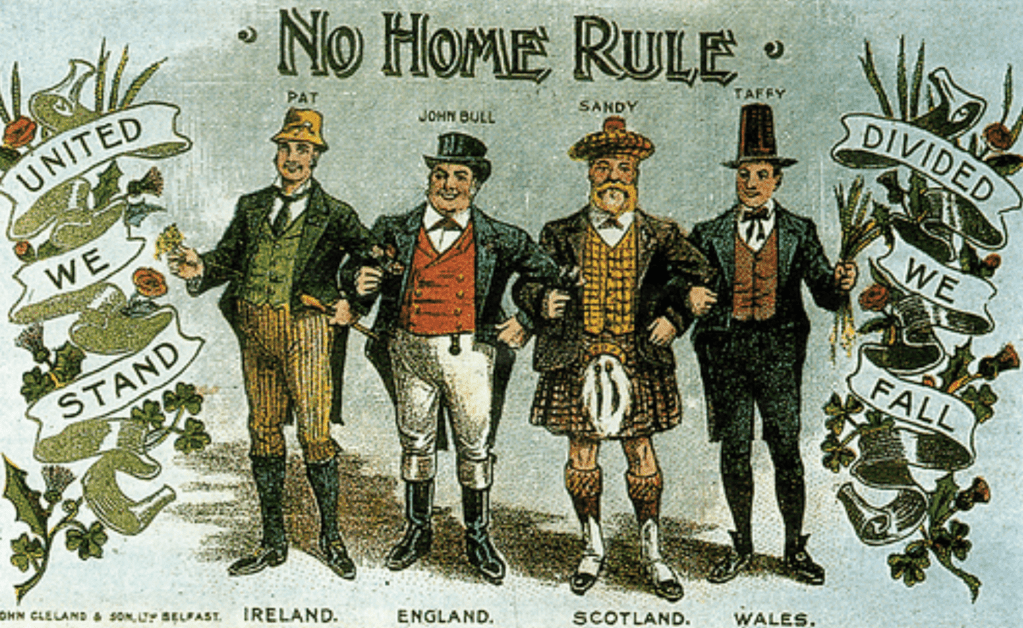
Paddy, Jock, and Taffy pictured in late 19th century English propaganda as friends in union with John Bull.
“Unionists used variations of these figures to project an idealised image of the harmony and unity that they saw existing inside the Union. The cartoon, entitled, “No Home Rule”…is a classic example of this approach, showing the four national stereotypes – Taffy is included to represent Wales – linked arm in arm and smiling warmly as they say in unison: “United we stand. Divided we fall.” …” featured on The Predominant Partner
Of course, it was fake then, and it’s fake now. This was all about creating colonised minds.
“A colonial mentality is an internalised ethnic, linguistic, or cultural inferiority complex imposed on peoples as a result of colonisation, i.e. being invaded and conquered by another nation state and gaslit, often through the educational system, into linguistic imperialism and cultural assimilation through an instilled belief that the language and culture of the coloniser are superior to their own heritage languages and cultures.”
Ireland 🇮🇪 Jackeens, West Brits, Shoneens
“In British-ruled Ireland, Irish people who displayed snobbery, extreme Anglophilia, or mimicked the English nobility and felt a cultural cringe regarding Irish culture, Irish nationalism, Gaelic games, and the Gaelic revival, were termed Jackeens if they were Dubliners, West Brits if they were Anglo-Irish or Ulster Scots people, and, if they were Irish Catholics and Gaels, to be suffering from Shoneenism.
“…the modern history of the Irish language revival is dated from Protestant Celticist Douglas Hyde’s 1892 manifesto, ‘The necessity for de-anglicising the Irish nation’.”
Scotland 🏴 North British, Scottish Cringe
“…even when the two countries had the same king after 1603 the English Parliament passed measures designed to curb Scottish competition with English trade. The most significant of these was the Navigation Act of 1651 which prohibited trade with the colonies “except in vessels owned by Englishmen or by the inhabitants of English colonies, and manned by crew of which more than one half were of English nationality”.
“The Education (Scotland) Act 1872 effectively put an end to non-English medium education and repressed Scottish Gaelic medium education, with pupils being punished for speaking the language. Pupils were physically punished if caught speaking in Gaelic and beaten again if they did not reveal the names of other students speaking Gaelic. The effect of the education act upon the Gaelic language has been described as “disastrous” and by denying the value of Gaelic culture and language, contributed to destroying the self-respect of Gaelic communities. It was a continuation of a general policy which aimed at Anglicisation.
“…’North Britishness’ is one of the most important and commonly used categories in tracing the progress of British nationhood, but tends to be taken for granted as a description of eighteenth-century Scottish identity.”
“Because of the history of internal cultural colonisation, many people growing up in Scotland can only respond to Scottish culture by blurting out words and expressions such as ‘parochial’, ‘narrow-minded nationalism’, ‘kitsch’ or ‘Brigadoon’. It is like an acute Caledonian strain of Tourette’s Syndrome.”
“…what we get is the ambivalence of a culturally colonised mentality and the resultant Scottish cringe informing what is taught or is not taught in our schools.”
Wales 🏴 Dic Siôn Dafydd
“A person who suffers from excessive Anglophilia, enthusiasm for the British Empire, and embarrassment about Welsh identity is traditionally known in Welsh culture as a Dic Siôn Dafydd.
“…a stereotypical Welshman who has consciously decided to forget his roots and turn his back on his nation, culture and language, influenced by a will to succeed in England. The 18th-century ballad describes Dic Siôn Dafydd as a pompous character that has grown up speaking Welsh but insists on speaking English even to his Welsh-speaking mother. Dic Siôn Dafydd is also known to be used as a term for abuse or as an insult that has political connotations. It refers to someone from Wales who betrays their nation for their own financial or political gain, or simply having turned their back on their country.”
“If the excessive Anglophilia and colonial mentality traditionally known as Dic Siôn Dafydd was never challenged or defeated [Saunders Lewis] predicted in 1918, “the Welsh Parliament would [only] be an enlarged County Council.”
(Sources: Diverse, including Billy Kay, Wikipedia, etc)
The message from London in the 19th century was that home rule was unnecessary. England and its Celtic neighbours lived in harmony, and Westminster was making decisions for Ireland, Scotland and Wales as some kind of wise benefactor. Even after centuries of colonisation and plunder many people in the Celtic nations actually believed this fantasy.
In the early 20th century, Home Rule bills for Ireland and Scotland were unsuccessful, not because the Irish and Scots were against national autonomy, but because the majority of English MPs at the Westminster parliament were against it.
Ireland, as we know, gained its freedom through armed rebellion. First in the unsuccessful Easter Rising of 1916, and once again following its defence of the unilateral declaration of independence made after the 1918 election. The alternative, according to some nationalists at the time, was that if Ireland did not reclaim its independence there was a danger that it would cease to exist as a nation. The Irish must look at Scotland today and think, ‘but for the grace of god’.

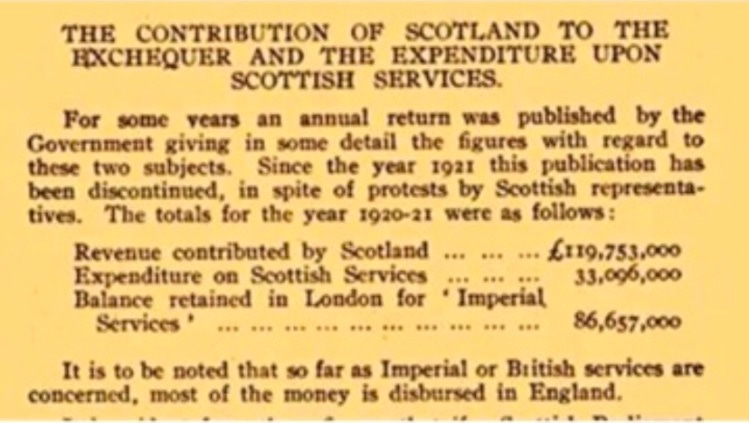
The reason Scotland was, and is still, held in an iron grip by the English ruling elite is that it serves as a cash-cow for the British state. Here’s an image posted by Leah Gunn Barrett on her SubStack blog of June 2024. These figures are particularly poignant as both of my parents were born in the second decade of the 20th century. As is clear from the amounts shown, they were born at a time when Scotland was being robbed of its very lifeblood. There was no obvious escape from this poverty apart from exile. Decades later, with Scotland being dismantled as a normal functioning state, it is no coincidence that two of we four siblings chose exile.
Today the colonial mindset has taken hold of Scotland’s ruling classes, from the judiciary, local councils, to Holyrood and Westminster politicians. Had we Scots escaped in the 1920s, along with Ireland, we too could have forged a prosperous nation and avoided scores of international conflicts as part of the British state. We could have saved our nation from the deliberate dismantling of our port and rail infrastructure. Our great national industries could have survived. Instead, we watched helplessly as the nation was de-industrialised.
The last published figures on exactly how much Scotland was contributing to the English (British, if you prefer) treasury are from 1921.
London and the British state has engaged in a long-term propaganda war against we Scots as a people, and against our status as a territorially sovereign nation. Modern anti-Scottish propaganda is aimed at destroying the independence movement and its leading voices. It employs home-grown housejocks in print and broadcast media, AI bots and trolls on social media, and agents and assets who are either compromised or cajoled into betraying their nation for financial reward – what other countries call traitors, committing treasonous acts.

Westminster’s goal is unchanged since union – to transform Scotland into an English region. Unless we reject London-based unionist parties and their Scottish mercenaries at Holyrood in 2026, England’s 19th century ambition of morphing Scotland into North Britain may become a reality, sooner rather than later.
With the failed Sturgeonist SNP formally giving up on independence, we desperately need an informed electorate with the same courage that Irish nationalists showed in 1918. On the political front, ISP, Alba and #IndyForIndy candidates are the only choice for genuine nationalists. On the non-political front, liberation.scot and Salvo are trail-blazing a path for international recognition of Scotland’s right to national self-determination.
We would do well to heed the words of Prof Alf Baird:
“the nation in colonialism is perishable… and what that means is, that as time goes by the nation itself will no longer really exist in any serious sense…”
The simple truth is – we Scots are the midst in an existential struggle.
 peteryoung.dk