From England’s Vassal State by Sandy McIntosh, author of “100 Home Rule Questions Answered”. First Published, April 1964.
Anglified Scots
Outside the British Isles Scotland is not a “recognised” country with separate nationhood, it is just part of England. The educated foreigner has great love and respect for Scotland, the country that fought so gallantly for centuries for liberty and independence and sent her sons to become prominent soldiers, sailors and administrators in the service of almost every country under the sun.
The average foreigner who has never visited Scotland has a mental picture of the Scot as a kilted, knobbly kneed individual with a whisky bottle in his pocket, a crooked walking stick in his hand, and a “meanness” that makes him a perpetual bargain hunter. That impression has been encouraged by English novelists whose books circulate abroad.
Unfortunately that impression gets verification in the eyes of the foreigner by the caricature of the Scot presented by some Scottish professional comedians. Of course, we have a quiet smile at the foreigner’s ignorance, but such an impression is not good publicity from a prestige point of view.
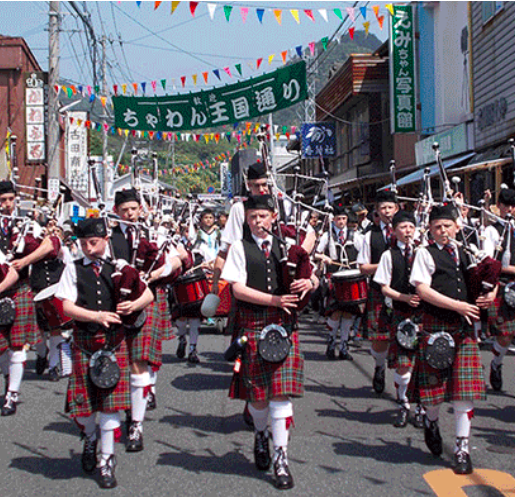
Before proceeding we should make it clear that the foregoing paragraph is not intended to disparage the wearing of the kilt. Far from it. The Tartan is not only closely associated with martial valour; it is the symbol of an ancient and revered democratic state or clan family society, linking those of Scottish blood the world over. English manufacturers, as well as Continental and Japanese, have not been slow to exploit the money-making potentialities of the world-wide lure of the Tartan.
It is not the foreigner’s impression of Scotland we wish to discuss here, however, but the present-day Scot’s outlook on home and foreign affairs. Most Scots would deny they were in any way “Anglified”, but facts are chiels that winna ding, and the facts are there to prove beyond doubt that the senior partner of the Union has given us all, more or less, an English outlook. This Anglicizing process was in operation long before the introduction of the predominantly English B.B.C. radio and television, which have simply accelerated the obliteration of a conscious independent Scottish outlook.
After 250 years of unequal Union with England it is difficult for the Scot to have a distinctive Scottish outlook at world events, even where these events affect Scotland. This obliteration of a Scottish outlook has not come about purely by accident, though it might seem the natural result of a small nation being swallowed up by a larger one. The obliteration of many things Scottish has been the definite aim of England ever since Union – and before !
An Englishman, Professor Cramb, once described the mission of his countrymen as being “to give all men within our Empire an English mind”. It does not seem as if the professor’s mission has been very successful except in that part of the Empire called Scotland. If we care to look beyond the self-satisfied platitudes and silly boasts like “Wha’s like us?”, we see, if we are honest, a proud, ancient country sunk to a despised province, weltering in its provincialism, and unconscious of its degrading vassalage to another.
The Scot has still enough sense of nationhood left to object to the use of the word “England” or “English” when “Britain” or “British” is meant, but the Scottish M.P.s. have never mustered enough courage (in case they would be called Nationalists?) to fight effectively against Britain’s foreign treaties being designated Anglo-this and Anglo-that, terms which makes a mockery of the supposed Union. When a Scot receives a letter from the Continent addressed “Aberdeen, England,” or “Edinburgh, England” his Scottish pride receives a jolt, but is he aware that such addressing is done by Continentals with the approval of the “British” Government?
The Scot also objects to the all too frequent reference to the Queen of England, the Prime Minister of England, and to famous Scots occasionally being called Englishmen. These protests and the “Hampden Roar” at an international football match are about the only signs of Scotland’s sense of nationhood and Scottish outlook.
Proselytising Schools
Mention has already been made of the lowered status of Edinburgh and Scotland in general, immediately following the transfer of the Scottish Parliament to London. To the detriment of Scotland this pandering to London and things English continues today, though Englishmen express great pleasure if they can trace Scottish blood anywhere in their ancestral tree. Scottish aristocracy and businessmen send their sons to England to be educated, or to English-type schools in Scotland. The boys leave home with little knowledge of their own land and return as ignorant of Scotland as when they left. They have been given an English mind, and have adopted habits, manners and aspirations which often make them strangers among their own people. What an English education does to these “young gentlemen” the B.B.C. and the National Press does, to a lesser extent perhaps, to the rest of the people of Scotland.
But surely, it will be said, the majority of Scots have been educated at Scottish schools, and these are free from English influence. Are they? Once again I cannot do better than quote Professor Andrew Dewar Gibb.
“There is also a propaganda by suppression, propaganda through silence. One measure of its efficiency lies in the contents of Scottish school-books – in the fact that they are tolerated, were it only for half an hour. It could happen in no other European country. These ignoble little works have played a very great part in persuading generations of Scotsmen that the only way for Scotland is the English way. Such events as Magna Charta and the Spanish Armada are treated as if they were part of British History. Chaucer’s poetry is crammed down infantile throats, whilst the very name of Dunbar is unmentioned. The Scottish schoolboys are invited to romanticise General Wolfe, who derided their country.“
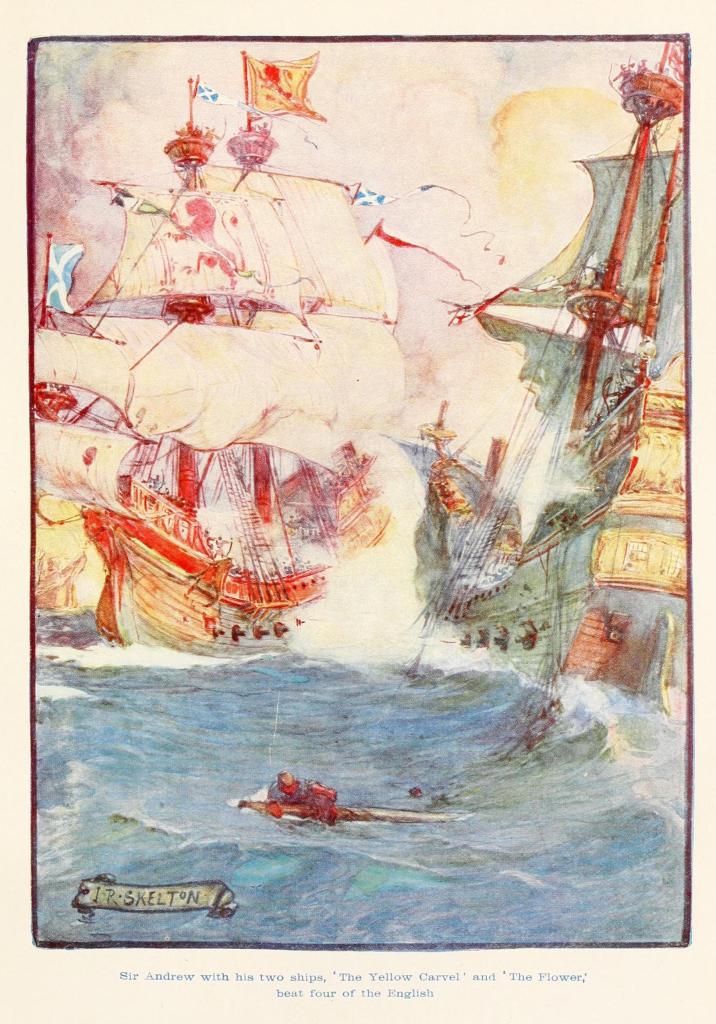
The Scot knows 1066 as the date of the Battle of Hastings, and some Scots even say “we” won the battles of Crecy and Agincourt, though at the time Scotland and England were bitter enemies. He may know something about the defeat of the Spanish Armada, but possibly has never heard of the Battle of the May, when two ships of the Scottish Navy routed five ships of the English Navy. He knows about Nelson, of course, but what does he know about Admirals Wood, Barton or Duncan? It is only within recent years that Scottish children have been taught something about the Declaration of Scottish Independence, signed at Arbroath on 6th April, 1320, a far more glorious document than Magna Charta.
Thanks to the enterprise of the citizens of Arbroath the signing of this Declaration forms the basis of a Pageant at Arbroath from time to time.
The pupils of Morgan Academy, Dundee, gave a boost to their city and Scotland several years ago by their performance in the radio programme Top of the Form. In the library of their school there are seven murals, each the subject of a historical scene. The subjects are:- The Battle of Hastings, Magna Charta, Sir Francis Drake Knighted by Queen Elizabeth, Raising the King’s Standard at Nottingham. Marlborough after Blenheim, Charles Edward Stewart meeting Flora Macdonald, and Captain Cook landing in Tasmania. Six English subjects and one Scottish. There is much to be said for broadmindedness and internationalism, but is this not carrying it a bit too far? For instance, the average English schoolboy would be flabbergasted if in similar circumstances his art master suggested the following murals for a school in, say Derby:- The Battle of Bannockburn, The Arbroath Declaration, Bruce being Crowned at Scone, The Raising of the Standard at Glenfinnan, Admiral Duncan after Camperdown. King Alfred Burns the Cakes, and David Livingstone in Africa. Six Scottish subjects and one English.
Several years before these murals appeared in the school library, the principal teacher of history in Morgan Academy, Mr Wm. Taylor, had said: “I have long felt, and stated in public on many occasions, that the least the Scottish Education Department can do is to set complete papers in Scottish history, both lower and higher, as optional papers to be taken instead of the present English history papers masquerading under the title “British.”
Anglification in greater or lesser degree by school and university teaching, anglification by B.B.C. radio and television, and by constant reading of news emanating in many cases from English news agencies – it is not surprising we have an English outlook on many current affairs though most of us are unaware of the fact because it has never been suggested to us to think Scottish. In politics, we see, or think we see, differences between Labour and Tory, but we seldom think of differences between Scottish and English political needs, though they definitely exist.
Of course, the Scot proudly proclaims his Scottishness on St Andrew’s Day, at Burns Suppers, and at international football matches with England. These are organised affairs, a way of letting off pent-up patriotic steam. England can afford to smile at such occasional outbursts, which help keep Scots happy and forgetful of their vassalage. To the thinking Scot these fleeting moments of Scottish patriotism throw into relief the constant, subtle brain-washing of the Scots outlook on political and world affairs. Let the Scots unite, however, in protest against Prestwick Airport being relegated to a minor role in international air services and the face of England changes. We are told quite bluntly that Prestwick must not be allowed to detract from the glory of London Airport.
Let the Scots show the least sign of political independence by putting a Scottish National candidate against the English-controlled parties candidates in a Parliamentary election and all the power of the Press is unleashed to keep the Scots believing there are only three proper ways to vote – Tory, Labour or Liberal, with emphasis on the first two.
In his own country the Nationalist, whose policy is Scotland First, is presented to the Scots as a political gate-crasher appealing for wasted votes. So far the Scots have shown little resistance to this mass propaganda, and have voted with servile obedience according to the political rules suggested by the English parties. The electorate of no other country in the world would support candidates of political parties based outside their country’s borders in preference to their own.

O wad some Pow’r the giftie gie us
To see oursels as ithers see us !
Reading the News
It has been shown that by education and a predominantly English Parliament, Press and B.B.C., the Scot has been Anglified, and undoubtedly acquired an English outlook on many things. Naturally he will want to deny this.
Let us put our suggestion to the test. Here are a few items taken from various newspapers. How quickly does the reader spot the un-Scottish aspect of these items? On behalf of the Scottish newspapers it must be said that with their reliance on agencies for news originating or passing through London they cannot always avoid publishing news which is English, in content or outlook.
1. In the Scottish Sunday Express, 20/10/63, Cummings, the cartoonist, had a picture of Macmillan sitting on the edge of his bed placing a crown on the head of his successor, Lord Home (now Sir Alex Douglas-Home). The caption read :
“But if the Pope is always an Italian why shouldn’t the P.M. of England always be a Scotsman?” Most Scots would, of course, spot that error. 256 years after Union the House of Commons is still “the Parliament of England”. Many a true word spoken in jest.
2. Referring to an American project to convert coal into petrol and oil, and thus transform depressed areas into thriving communities, Dr Alastair Ward, Glasgow Evening Citizen, 21/8/63, said this was something from which the Scots could learn a lesson. Comment – The Americans have nothing on Scotland’s London Government. By imposing a crushing tax on oil produced from Scottish shale and thus forcing the industry to close, that Government transferred a thriving community into a depressed area.
3. The Perthshire Advertiser, 21/9/63, referred to Scottish industrialists “who are slow to demonstrate their faith in Scotland’s future”. Of course, the lack of investment in Scotland was meant, but how many Scottish industrialists and ordinary Scots have sufficient faith in Scotland to believe she could manage her own affairs through her own Parliament? In fairness to the Perthshire Advertiser it should be complimented on being one of the few Scottish newspapers that give regular space to the expression of Scottish National opinion.
4. The Dundee Courier, 4/10/63, gave praise to Ireland’s Foreign Minister for the powerful plea he made in the U.N. General Assembly regarding the best way to maintain the momentum of the Test Ban Treaty. Our comment – Puir Auld Scotland! An “unrecognised” nation among the self-governing countries of the world because she has no government of her own, she can have no say in Commonwealth or United Nations affairs.
5. The Sunday Post, 26/6/60: “The credit squeeze gets tighter. Nobody likes it. In particular, it hits Scotland most unfairly. Scotland, much more than England, needs a free flow of money and trade expansion. How else can its thousands of workers find work?” Comment – The credit squeeze (through increased bank rate) was intended to stop over-spending in England. Conditions were the reverse in Scotland but “differential Bank Rates” could not be applied in a United Kingdom ruled by one predominantly English Parliament. The real solution was a Parliament for Scotland that would devise policies suited to Scotland. Instead, Scotland was allowed to suffer for England’s sake.
6. In the Scottish Sunday Express, 22/12/63, Colin Cross devoted the centre page article to advising the Prime Minister to visit China. The article ended with these words: “If Sir Alec, like Mr Macmillan before him, can satisfy this hunger in the British for greatness, his future as Prime Minister will be assured for many years to come”. Comment – Nothing could be more un-Scottish or more English. Scotland has hungered for independence, but never in her history for greatness. We are a democratic, peace-loving race, and while we do not wish to live in isolation or shirk our responsibilities our outlook on life was admirably expressed over 600 years ago in the Declaration of Scottish Independence: “We desire no more than is our own… and for the sake of peace are willing to do all within our power”.
7. The Glasgow Evening Citizen (27/11/62) had an editorial supporting East Kilbride’s claim for burgh status. The last paragraph read: “Burgh status will not solve all East Kilbride’s problems. But if they are given control of their own affairs the citizens will have an extra incentive to better their town”. Comment – Would not Home Rule for Scotland and control of our own affairs give the Scots an extra incentive to better their country ?
8. Before Mr George Younger, Conservative candidate in the 1963 Kinross and West Perthshire by-election, stood down in favour of Sir Alec Douglas-Home, he is reported to have told an audience that “we regard it as essential to give everyone the chance to run his own affairs; only in this way can we get the necessary enthusiasm and independence of mind to run the country well”. Comment – Why not apply this admirable policy to his own country, Scotland ?
9. The middle page article of the Scottish Sunday Express of 9th September, 1962, dealt with the Commonwealth conference in London that week. Britain seemed determined to enter the European Common Market, and the writer, A. J. P. Taylor, said:
“It is a choice between independence and surrender. Independence is not isolation. It does not mean withdrawal from world affairs. On the contrary, it is because of our independence in the past that we have counted so much and have contributed in a way for which every country in the world has reason to be grateful. By defending our own freedom we have secured the freedom of others”. Comment – But let Scotland seek independence, and the Sunday Express and other newspapers, as well as British politicians, will talk about narrow Nationalism, isolation and loss of prestige in world affairs.
10. And, finally, a bouquet to the Scotsman. Commenting on the report of the Highland Advisory Panel following their visit to Norway, that paper said: “In fact, the great lesson of the report, which the panel does not draw, is the stimulus of independence”. Enough said !

The foregoing may not be the most outstanding examples of presenting news and opinions from an English (British, they call it) point of view, or unconsciously supporting the Nationalists’ arguments for Home Rule for Scotland. The examples were taken from newspapers that came readily to hand. Read our newspapers carefully and see how many similar examples you can spot.
There is an item of news which appears in most newspapers week by week or month by month; news that gets only a casual glance unless it includes the name of a relation or friend of the reader. I refer to the regular publication of a list of estates of deceased persons. How many Scots realise that the death duties paid on such estates have a bearing on Scotland’s economy?
Not only does a London Treasury demand its share through income tax of the wages, salaries or profits earned by Scots, but it claims a substantial share of the estates left by deceased Scots. Here is a brief summary taken from ONE Scottish newspaper of the estates of deceased Scots in Angus (excluding Dundee), Perthshire, Fife and Aberdeenshire. There were 20 to 30 estates given for each county, and the totals for each were £231,508, £223,180, £321,077 and £750,973. Of the seventy estates mentioned the biggest estate was £543,060, and there were thirty under £2,000.
There is no need to work out the total death duties taken by the London Government, but it claimed well over £300,000 of the £543,060 estate, and £56,029 on an estate worth £111,374.
All of these death duties represent a drain on Scotland’s wealth – money taken out of Scotland to be spent as London wishes. Scotland becomes poorer and London becomes richer whenever a Scot dies ! Keep these facts in mind next time you see a published list of Scottish estates.
What Others Say
ROBERT BURNS, Scotland’s National Bard: “Alas! I have often said to myself. What are all the boasted advantages which my country reaps from the Union that can counterbalance the annihilation of her independence and even of her very name ?”
LORD COOPER, the late Lord President of the Court of Session: “In matters commercial, industrial, financial and political, we are rapidly succumbing to a process which, unchecked, can only end in degrading Scotland to the level of a minor and decaying English province.”
KEIR HARDIE: “When the men elected to make laws are but a small part of a foreign parliament, that is when all healthy national feeling dies”.
REBECCA WEST: “If a man does not love his country enough to concede its right to self-government, he will end by not loving it at all”.
RICHARD COBDEN, noted English politician, told a Manchester audience what an excellent thing Union was for England, and that if the countries should separate once more the Scots “might have a government wholly popular and intelligent to a degree which I believe does not exist in any other country on the face of the earth”.
DAME FLORA MACLEOD on her return from a goodwill trip to America in 1952: “A Scot is already a success when he arrives. Everyone will be his friend. But there is a definite barrier between Americans and Englishmen”.
PROFESSOR ANDREW DEWAR GIBB: “In fact and in law Scotland became and has remained a province. That is a grave statement, but unfortunately not an untrue one. It sums up a situation which to men who love their country sanely is literally unendurable … Scotsmen have been industriously plied with the idea that it is for them a choice between Union” (with England) “and near starvation, a miracle of propaganda which yields in no way to the mendacious triumphs of Goebbels and the Kremlin”.
LORD BOYD ORR: “If our Scottish people had the power to develop the natural resources of our country for the benefit of our own people, we could put Scotland in the very forefont of the nations”.
ALEXANDER MALCOLM MACEWAN: “The objections to Home Rule are not so much reasoned as vague apprehensions, but fear is often more potent than reason, and must be dealt with … The answer to all the misgivings as to what a Scottish Parliament might or might not do is that Scotland is a nation of sufficient strength and independence and experience of public affairs to find a solution of her own problems”.
(DR) AGNES MURE MACKENZIE: “The enemy of Scotland nowadays is less the Englishman, who is often her friend, than the Anglo-Scots Quisling, who is always her foe”. (From Scotland in Modern Times)
JAMES ANTHONY FROUDE, the great English historian: “With the exception of the Greeks and the Hebrews there is no small nation to which the world owes such a debt as Scotland”.
And About England, too – By the English
The closing lines of a poem published by the London Times in 1940 :
“Thou art our inspiration, for in
thee lies the soul of the Earth. England!”
HENLEY’S famous England, my England, frequently included in poetry anthologies used in Scottish schools:
“England, my one for you,
What is there I would not do,
England, my own ?
With your glorious eyes austere,
As the Lord were walking near,
Chosen daughter of the Lord,
Spouse-in-chief of the Ancient sword…”
CANON OF ST PAUL’S CATHEDRAL (1957) :
“In this dim world of deepening storm and shadow
Must not our hearts,
O England, turn to thee ?
For the true path
Man’s troubled soul is groping,
Be thou to him as tranquil lights that burn …
And let it be thy final page of glory,
That all men’s hearts,
O England, turn to thee”.
Love of one’s country is commendable, but Scottish Nationalism even at its most extreme has never come within miles of approaching these remarkable exhibitions of religious nationalism. Search the works of Burns from cover to cover and you will find patriotic poems a-plenty, but not a line that suggests the love of Scotland is a substitute for the love of God.
Summing Up
Enough evidence has now been presented to verify the claim that Scotland is a vassal state of England – politically, economically, and militarily, and Anglified in outlook. There is not an adult Scot who can escape his or her share of responsibility for Scotland’s present-day vassalage to England. When, as has been said, the majority of Scots desire a Parliament for Scotland, why don’t they have the courage of their convictions when they reach the polling station during a Parliamentary election? What influence or fear stops them voting for Home Rule?
Throughout the year whenever a newspaper discusses politics there are two brands of politics that get the limelight – Tory and Labour, with the Liberals occasionally thrown in for good measure. The activities and policies of Scotland’s own Party, the Scottish National Party, are ignored, played down or ridiculed. During a General Election the massive power of the English political propaganda machine (radio, television, platform speeches, Press and posters) is turned on full blast to impress upon the electorate that they must vote Right, Left or Middle (the Middle being Liberal) to form a British government. In this political civil war the three English-based parties claim a monopoly of the B.B.C. for propaganda purposes. With the approval of these three parties the Scottish National Party is not allowed to broadcast. Under such a storm of brain-washing it is small wonder that thousands of Scottish voters overlook the main issue as far as Scotland is concerned, namely, the welfare of Scotland – to be ruled by Scots in Scotland or by Englishmen in London?
There are those Scots who say that by voting for a Home Rule candidate they will be letting the other party in, “the other party being one of the English parties. That is negative voting, as opposed to positive voting which means voting for a belief or principle. It is playing int Ingland’s tactics of “divide and rule.” This unspoken English policy may be described thus: “Don’t give the Scot time or opportunity to think about his own country’s needs. Make him believe our political fight is his. Set Scot against Scot; get him to take sides, then whichever side he favours England will continue to rule Scotland.” It’s simple, and, unfortunately for Scotland, successful so far.
Does the Scot ever stop to think that however Scotland votes along British political party lines it won’t affect a Westminster Parliamentary election? Indeed, on more than one occasion the majority vote in Scotland has been cast in the opposite direction to the majority vote in England, and we have then been ruled by a nation of an entirely different political opinion. The English can look after themselves. It is time we put SCOTLAND FIRST. The return of even one Home Rule M.P. (to begin with!) would mean more attention being paid to Scottish affairs at Westminster. Six would really alarm the London Parliament and ensure action on Scotland’s behalf. Thirty-six would bring self-government within our grasp.
A Scot of all persons should have the courage of his convictions and vote for a principle. A vote for a principle is never a “wasted” vote. If those in Scotland who desire a Scottish Parliament voted for Home Rule candidates, Scotland would have a majority of Home Rule M.P.s.
Sometimes a Scot will say he votes Labour because the Labour Party has done so much for the working man. Has it ever occurred to him that had Scotland retained her own Parliament the probability is that such benefits as he thinks he has received through an English Labour Government would have been his much earlier? Scotland always was less class conscious and more democratic than England. Is such a Scot aware that in 1914 the Scottish miner was better paid than was the English miner, but in 1950, under a Labour Government, received one shilling per shift less? Further, from 1945-48, during Labour’s term of government, the average income per head for all Scotland fell by 9 per cent, but only by 5 per cent, in England. A self-governing Scotland with control of her own wealth and economic policies could easily raise Scotland’s living standards without placing extra burden on her taxpayers. Comparing Scotland’s actual wealth with that of other countries the foregoing statement is not just a vain hope. It is a prospect based on sound economics.
Red Clyde Bogey
Unlike the Labour Party, which only became “Unionist” after the 1945 election, the Conservative Party has always been Unionist. Within the ranks of the Scottish Conservatives, however, there are many beginning to doubt the benefits to Scotland of an unequal union with England. Their only fear is that a self-governing Scotland would be ruled by Socialists. They forget that a Socialist Government was swept into power in 1945 by an overwhelming majority of English votes, while Labour leaders upbraided Scotland for not playing her part in the Socialist victory! In any case, is there not something shallow or “pro-English” about this objection when Greater London alone has more M.P.s. in Westminster than has the whole of Scotland? These London M.P.s. could, if they cared, out-vote all Scottish M.P.s. in deciding a matter affecting the welfare of Scotland.
Scottish votes are meantime about equally divided between English Conservative and English Labour. In a self-governing Scotland the political divisions might not be the same as at present in Westminster. Other countries that have broken the shackles of Westminster rule have not slavishly followed the English pattern. Scotland would have problems peculiar to herself, and it would be on the settlement of these problems the Scots would vote. We can rest assured that whatever form of Government we had, the chief aim would be the welfare of Scotland. That has never been and never can be the chief aim of Westminster. Who can doubt that with independence and a new and proud sense of nationhood there would arise a sense of Scottish brotherhood?

And now a word to the diehard Tories, the nobility, the business magnates, and those Scots further down the social scale who seem to think that being Conservative and anti-Home Rule is some kind of badge denoting political and social responsibility.
Little need be said about our Scottish nobility. With one or two notable exceptions history portrays them as anything but friends of their native land. Scotland has had far more Quislings among her nobility than Norway or France had collaborators during the Hitler war. There may, of course, be a Bruce among our present lot, just biding his time in the service of “the enemy”, as did Bruce before taking a leading part in Scotland’s fight for independence.
As for Scotland’s big businessmen, it cannot be they think a self-governing Scotland would be a poor country compared with her present position. All the evidence points to the fact that Scotland is one of the richest countries in Western Europe, with her development ham-strung by having her revenue filched and dissipated by an alien Treasury outside her borders, and by the imposition of economic policies devised to meet England’s and not Scotland’s needs. Self-governing countries of comparable size to Scotland, with less revenue and fewer natural resources, are forging ahead while Scotland lags behind. Many an able Scot who has no inclination towards a political career in London would gladly serve his country in a Scottish Parliament, and under self-government business would be better even for the big business Tory. Do such big business Scottish Tories ever ponder the fact that big business in America, Canada, Australia and New Zealand lost nothing by breaking the fetters of Westminster control? Do they ever think of the world-wide goodwill towards Scotland, or “the stimulus of independence,’ as The Scotsman so aptly said? Meantime the big business Scot is more than comfortable, and his reluctance to risk any change is understandable, but to favour an unequal Union in the hope of being the recipient of some honour, which England gladly bestows on faithful serfs, is despicable.
The third group of Tories referred to, those further down the social scale, are unconsciously but surely and smugly “Anglified.” Their political allegiance seldom flows from conviction, for conviction comes from purposeful study of many sides of a problem. They are the “Follow, Follow” brigade, with a blind self-satisfied faith in Toryism handed down by their father or grandfather, or recently acquired after setting a foot on the social ladder. As a rule they are nice people to meet socially, and it seems almost a shame to disturb their political tranquility. They, too, will benefit when Scotland controls her own affairs.
It cannot be that Scottish electors will go on much longer accepting what is thrust upon them in the name of party loyalty. It cannot be that we have run out of honest men and women who are capable of serving Scotland in Scotland’s interests, even at a sacrifice, if necessary; men and women who will re-inspire the mind and re-light the spirit of Scotland, and put it where it once was and can be again, in the forefront of the nations.
As the writing of this booklet draws to a close the newspapers make it clear there is widespread dissatisfaction with the handling of Scottish affairs by our masters in London.
The Secretary of State, it is complained, is lacking in influence with English Ministers who also deal with Scottish affairs. The campaign against railway closures has become a NATIONAL one. Opposition to the Plan for Central Scotland comes from many quarters. A Plan covering ALL Scotland is wanted – a Scottish NATIONAL Plan.
Opposition on a NATIONAL (Scottish) scale to the Winter Keep Scheme comes from the Scottish farmers. The Scottish T.U.C. holds a conference of Scottish M.P.s. of all parties to consider a separate economic plan for Scotland.
The Scottish Council (Development and Industry) protest to the Minister of Aviation that the threatened reduction in Prestwick’s international air service would be “a threat to industrial growth in Scotland.” Protests of all kinds and on all matters.
But why should a nation like Scotland have to be governed by protests? It is all very well saying these protests are non-political. They are addressed to a Government that holds political power. The protests are laudable, but unless groups combine on a Scottish NATIONAL basis, their protests will never be really effective. All these protests to an alien government outside Scotland’s borders surely point to the need for Scotland to unite politically and take Scottish National political action – at the Polling station.
Self-government won’t be handed to Scotland on a plate by England. Even if the Scots are ignorant of their country’s wealth there is no ignorance on the part of England’s political and financial leaders. For over 250 years they have controlled that wealth to help maintain the glory of England, and won’t relinquish their control without a struggle. Their attitude has not changed since the English Speaker of the first Union Parliament declared: “We have catcht Scotland and will keep her fast.”
Few countries have broken the shackles of Westminster control and vassalage to London without a desperate struggle. The Scots have a fight on their hands, and it is time they bestirred themselves.
It was said of Jairus’ daughter, “The maid is not dead but sleepeth.” If political Rip Van Winkle Scots do not bestir themselves and act on their country’s behalf soon by VOTING for their country’s right to be an independent and “recognised” nation, Scotland will be completely absorbed as thirty-two counties of Greater England, and the world will be able to say,” Scotland sleepeth not but is dead.”
Cult of Bigness
Opponents of Home Rule often tell us that the tendency today is not separation but towards larger and larger units. This is one of the arguments encouraged by Westminster politicians and a national Press that are scared of Scotland recognising her vassalage. Unfortunately many Scots accept the statement as truth. Those who put forward such an argument are either stupid or dishonest. Larger and larger units indeed. Name one. Not a single larger unit (union of countries) since the First World War, while dozens of countries have won their independence.
If you are a Scot, it is almost certain that in your heart you believe Scotland should end her vassalage to England and control her own affairs through her own Parliament.
The kind of Parliament doesn’t matter meantime. We have the genius, the stability and sufficient knowledge of public affairs to establish a democratic Parliament suited to Scottish needs.
But what are you DOING to hasten the day? No country ever won independence by simply wishing for freedom. Make up your mind that Scotland MUST be free, then help hasten the day by voice or pen or money – and your VOTE. I suggest you support the Scottish National Party, but if you think you have a better method by all means adopt that method NOW.
The grip that English political thought has on the minds of Scots is much stronger than most Scots realise. Here is a simple test of your Scottish patriotism. Let us suppose there is a General Election tomorrow. In your constituency there are four candidates – Conservative, Labour, Liberal and Scottish National. How would you vote? On your answer depends Scotland’s future.
The following lines by Adelaide Proctor (the last two have been altered) might have been written as a clarion call to present-day Scots: –
Rise! for the day is passing,
And you lie dreaming on;
The others have buckled their armour
And forth to the fight have gone.
A place in the ranks awaits you,
Each man has some part to play,
The future is YOURS for the making,
It depends on your part TODAY.
“This is NOT the end. Scotland’s Parliament will meet again.”
Fletcher of Saltoun (1707)
A patriot who refused to sign away Scotland’s independence.
The Parliament Restored
Imagine Edinburgh and the rest of Scotland when the Parliament comes again. The rejoicing as the bells peal forth the fact that Scotland is no longer a vassal state or northern appendage of England, but a “recognised” nation again with a REAL Capital housing her own democratically elected Government.
A proud, independent nation extending the hand of friendship to all freedom-loving countries, and accepted gladly by other members of the Commonwealth as an equal.
Her Parliament expressing Scottish opinion on home, Commonwealth and world affairs. The voice of Scotland on the air, and a Press that is the mouthpiece of a free and respected nation. Her statesmen and politicians, members of trade missions, and ambassadors and other plenipotentiaries, frae a’ the airts walking the streets of a re-vitalised Edinburgh.
A nation again, with the inevitable incentive that comes from independence. A nation devising economic policies to suit her own needs, formulating her own National Budget, spending her own revenue on priorities of her own choosing. And the money circulating throughout Scotland instead of across the Border.
Revival of Clyde, Forth, Tay and Don as convenient ports for trans-Atlantic and European trade, with ships on the seven seas flying the Scottish flag, and Scotland’s airlines a further reminder of
SCOTLAND RESURGENT!
 peteryoung.dk