Joint Paper by Lynda Baird & Alf Baird
Cultural Heritage
Heritage theory emphasises values and significance (Figure 1) when evaluating monuments (Fredheim and Khalaf 2016), albeit views differ from the standpoint of different stakeholders, elites and cultures. Memory and forgetting in representation and mis-representation and commemoration also plays its part. In the colonial environment, native history and culture tends to be intentionally diminished, obliterated even, and it is primarily the values of the coloniser which are sovereign (Memmi 2021, 56).
Monumental legacies don’t need to be permanent features as Riegl (1902) thought during what may have been the modern Imperial pinnacle period over a century ago. Cultural obliteration (i.e. destruction of native culture), which is an aim of colonialism, tends to leave a legacy of symbols and monuments commemorating ‘superior’ oppressor elites (Fanon 1970, 190). Oppression of native cultures is a feature in this process, resulting in different narratives and versions of the past being presented (Harrison and Hughes 2010). Here there is a need to consider and apply decolonial thinking to understanding cultural heritage (Knudsen et al. 2022) in the context of Scotland’s possible independence and decolonization.

Conservative authorities invariably seek to defend Imperial/colonial structures and narratives (Mignolo and Walsh 2018), or even to deny oppression (Hicks 2021, 26), and tend to avoid discussion or understanding of legacy heritage resulting from oppressive exploitative regimes (Barassi 2007). The range of values attached to heritage requires mainly an anthropological perspective (Mason 2002, 27), yet a difficulty arises in the Scottish context because perceptions of colonialism (still) tend to be obscured. Consequently, a people seeking independence may often have only a rudimentary understanding of the true extent of their ‘wretchedness’ (Fanon 1970, 110).
This creates a need for thoughtful reinterpretation’ to allow for ‘deeper understanding’, in turn ‘adding new layers of meaning’ (Historic England 2021). Removing heritage is also about clearing the way for a new collective memory (Benton 2010), reflecting improved understanding of the cultural context. Institutions current focus on ‘decolonization’ relates to perspectives of classical colonialism and slavery including the BLM (Black Lives Matter) movement. However, Imperial and colonial oppressions were also levelled against white ethnic groups in Europe, including the Scots, Irish, and Welsh, each (still) subjected to Anglocentric Imperial cultural superiority and oppressive policies (Hechter 2017, 64) and not dissimilar to Asian and African colonies (Said 1994, 287).
Colonial Monuments
An oppressed people rightly question if they should have to walk past symbols of oppression and inequality every day, such as monuments left by an Imperial power. Whether such statues are ‘educational’ or not in the colonial environment is another matter, and here it is usually dominant elites who hold the narrative and values of the colonizer sovereign (Memmi 2021, 56) in what remains an elite ‘infrastructure of colonialism’ directed at subordinate conquered indigenous groups. Historic dispossessions emptied much of Scotland of its indigenous people, obliterating their culture and language; this brings us into the realms of ethnic cleansing, and genocide (Hunter 1977) and, in terms of ‘cultural genocide’ the process may not have ended (Grouse Beater 2021).
Ecological Imperialism’ further implies that Imperial elites also sought “to change the local habitat” (Crosby 1986, 196), replacing people with sheep being an example, and various other schemes (e.g. SSSI’s; National Parks; Highly Protected Marine Areas etc.) which constrain local economic development potential. Thus,everything that belongs to the colonizer is not appropriate for the colonized” (Memmi 2021, 172), including it might be added his grand monuments and dubious values.
Cultural Imperialism results in an alien culture, language and cultural hegemony (and its values) being imposed on a people (Buttigieg 1992). In such a colonially manufactured environment, an oppressed people may develop a ‘colonial mindset’ which leads to their own denial and/or downplaying the reality of discrimination or any past history of racism. The dominant coloniser is thus “custodian of the values of civilization and history” forcing the colonized to accept his (alien) values and his monuments of self-glorification (Memmi 2021, 120).
Colonial exploitation is always a co-operative venture aided by native elites, whereby the latter become “part of the group of colonizers whose values are sovereign” (Memmi 2021, 56). Under Imperial rule it is only ever the ‘mother country’ which exudes “positive values” (Memmi 2021,104); this is clearly an important factor in considering the development and significance of monuments and other symbols in a contested territory where such monuments may only be accepted by the more assimilated native.
Heritage Values and Significance
In seeking to preserve heritage, it is important to consider “the meanings and values attached to objects (that)provide the very reason for conservation” (Pye 2001, 57). A key task here lies in identifying the ‘values’ which constitute the significance of heritage. Significance in this sense is understood as the overall value of heritage or “the sum of its constituent ‘heritage values’” (Fredheim and Khalaf 2016, 466). Identity at the national level is considered to be the most important factor here, which, in this instance, reflects aspects of value and significance in the context of those holding to a British identity (Howard 2003, 148) as opposed to a Scottishidentity (Bond 2014).
It is considered that values-based approaches may fail where “decisions are based on incomplete understandings of heritage and its values” (Fredheim and Khalaf 2016, 467). Different people will inevitably hold different views about heritage values, depending on their culture, identity, and values. Identities and cultures come into play because national identity and national consciousness is itself a cultural emotion heavily influenced by national culture and indigenous language, as well as by cultural assimilation policies (Fanon 1970, 190; Baird 2020, 53; Memmi 2021, 150).
People from different social backgrounds, traditions, professions, and cultures therefore tend to express different values (Pearson and Sullivan 1995, 308-309). Heritage values may be rather subjective with, usually, a “tension between institutional or ‘official’ values, and the values people produce” (Ireland, Brown and Schofield 2020, 824). There are also differences in assessing ‘value’ (Fredheim and Khalaf 2016, 471). Critical in this regard are features that make the heritage significant; what aspects are of value, and what are the qualifiers of value allowing value determination assessing its ‘value’ (Fredheim and Khalaf 2016, 471).
The term cultural significance is closely associated with The Burra Charter (Australia ICOMOS 2013). Significance also relates to the particular ‘nation’ of people from which values are constituted and measured (Tainter and Lucas 1983, 707), hence the term ‘national heritage’. In the colonial context, there is clearly going to be a difference in what is meant by ‘national heritage’ as opposed to the heritage of other nations and peoples, including the heritage and values of another dominant nation that may have been imposed on a people.
In a colonial environment the legacy of capitalist and colonialist perspectives as defined by the dominant culture and settler groups obscure this reality. Marginalized and oppressed native groups tend to be excluded from heritage decisions, with dominant groups including authorities reflecting and projecting only the dominant culture making most of the decisions (Baird 2020, 306). This necessitates greater emphasis on adopting inclusive values typologies (Ireland et al op cit. 2020a, 831) or, in the case of decolonization, taking a completely fresh approach prioritising native national identity, culture and values.
Individuals Commemorated
This research considers the decolonisation of cultural heritage within a Scottish context with emphasis on a possible post-UK union reality and an independent (i.e. postcolonial) Scotland. In this scenario certain monuments may be viewed as a legacy of colonialism. Many monuments are already considered contestable in regard to Scotland’s history and heritage.
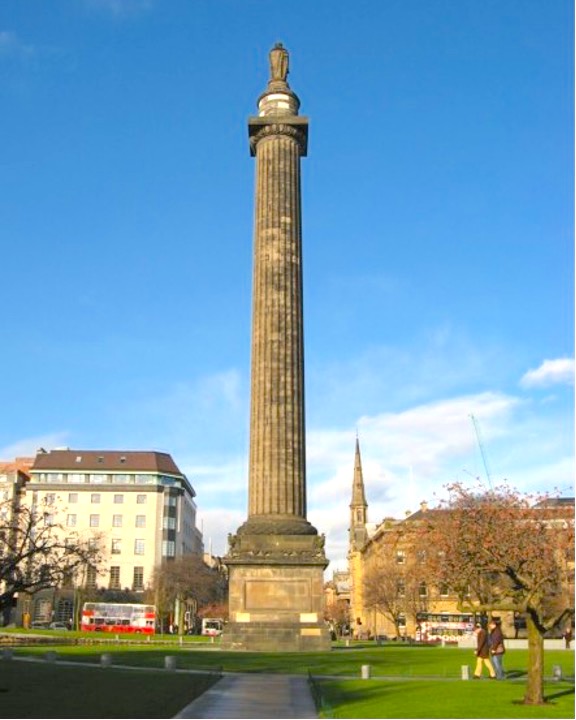
The Lord Melville monument in Edinburgh (Figure 2) commemorates Henry Dundas who, as Lord Advocate, basically ran Scotland on behalf of the British state during the period following shortly after the war of independence (or ‘rebellion’) of 1745/46. Known as ‘The Great Tyrant’, evidence suggests Dundas’ main role was to ensure that Scotland and the Scots were kept in line with British Empire objectives; the main function of Scotland (as with Ireland and Wales) being to provide a resource (food, goods and people) for the British Empire’s sustenance and corporate-military expansion (Hechter 2017, 83). Whilst this may have been positive for Scotland’s tiny elite and mostly Anglicised governing class, many of whom were by now based in London most of the time and therefore absent from Scotland, it was rather less than advantageous for the mass of Scots or the further development of the Scottish nation. Dundas, who was also Minister for War and Colonies, is therefore commemorated by a British Imperial power for his contribution to furthering Imperial domination (at home and abroad), and for acting more or less as Scotland’s ‘Governor General’ overseeing and subjugating what was and remains even today a restive ‘internal colony’ (Hechter 2017, 27).
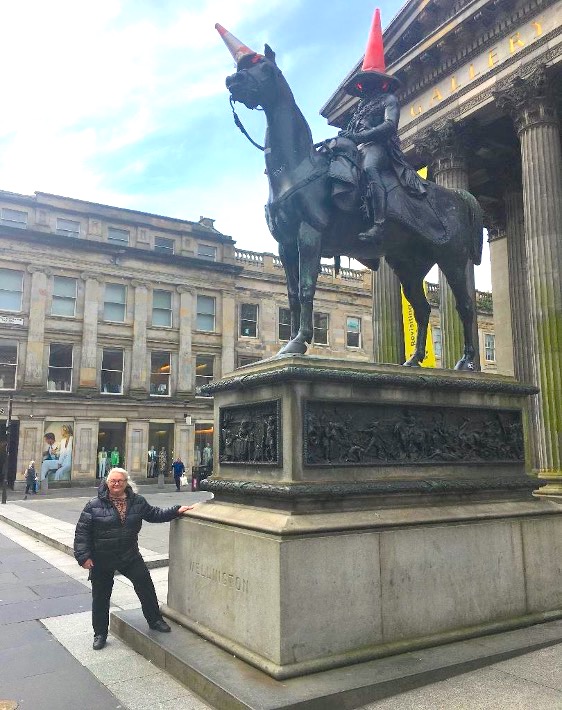
The Duke of Wellington statue in Glasgow (Figure 3) commemorates Arthur Wellesley who was born into an Anglo-Irish aristocratic family. Wellesley combined a long political and military career. He returned from India with a fortune in ‘prize money’ after leading numerous military campaigns which effectively destroyed native peoples and cultures enabling their economic exploitation and the plunder of India by voracious British corporate interests. Wellesley was basically therefore a corporate mercenary leader, another part of Britain’s extensive global ‘militarist-corporate colonialism’ (Hicks 2021, 16). Such an elite were automatically in receipt of titles and privileged positions including being given senior roles in British governments. Wellesley’s connections with Glasgow or indeed with Scotland appear non-existent, though his statue there may reflect a desire by local elites to align with and project British Imperial superiority, values and power from which such elites were also prospering and co-opted to maintain.
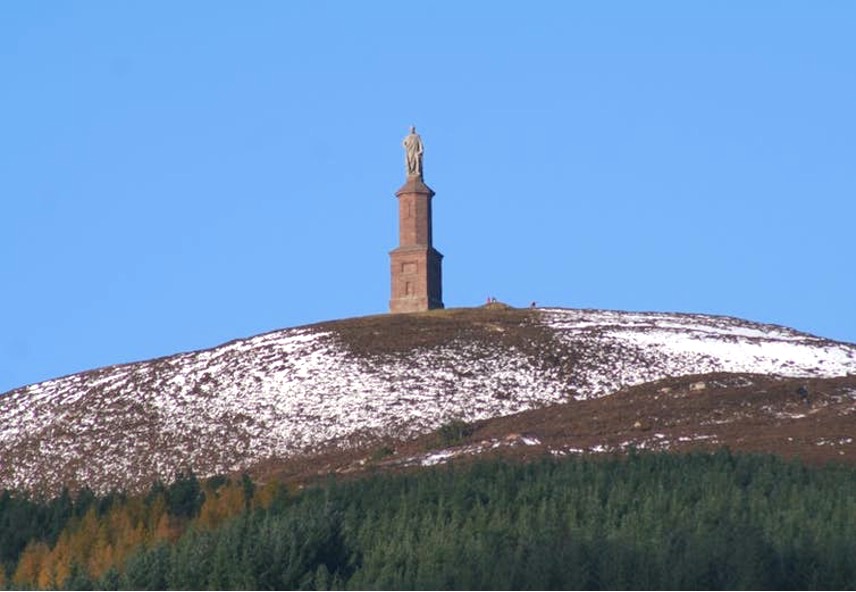
The Duke of Sutherland monument in Golspie (Figure 4) commemorates George Levesen-Gower, 2ndMarquess of Stafford who married the Countess of Sutherland. Leveson-Gower was also an MP and British Ambassador to France during the French Revolution. The county of Sutherland and other parts of Scotland were cleared of thousands of indigenous native Scots families by Leveson-Gower and other landowners. This followed the earlier removal of people and forfeiture of lands throughout Scotland owned by Jacobite ‘sympathisers’ by British government forces. Removal of Scots from Scotland was subsequently further achieved through British government legislation such as Empire Resettlement Acts. Legislation and policies were therefore employed by successive British governments to remove Scots from their homeland and to obliterate their culture; this is precisely the aim of Cultural Imperialism (Phillipson 1992) and colonialism, which is at root racism (Memmi 2021, 42). The Leveson-Gower statue does not therefore appear to commemorate anything other than Imperial oppression and barbarity inflicted by a tyrannical elite on a ‘subordinated’ ethnic indigenous group (i.e. the Scots).
Summary
Perceptions of what is or is not acceptable in any society changes over time. We now see a renewed push for Scottish independence after Scotland’s enforced withdrawal from the EU, and repeated electoral mandates for another referendum ignored by UK governments. There is consequently increasing awareness of Scotland’s rather powerless colonial status and related political, economic and cultural domination. Fundamental political change of the magnitude of independence implies that a quite different perspective may arise regarding what is meant by ‘national’ cultural heritage in Scotland, also reflecting Frantz Fanon’s view that independence is ‘a fight for a national culture’.
Riegl’s (1902) ‘Modern Cult of Monuments’ emphasised the role of Imperial/colonial rule by another (i.e. alien) dominant people and culture. The importance of ’culture’ in determining significance of heritage influencing values assessments is self-evident. Accumulation of heritage and collective memory is also influenced by a people forgetting its past, aided by dubious oppressor narratives promoted in the colonial setting, the latter’s values reinforcing a dominant culture, as well as its myths.
In the colonial situation, archaeological practice has also often been carried on by people with no historical or cultural ties with the peoples who’s past they were studying (Trigger 1984); only around ten per cent of the academics in Scotland’s elite universities today are Scots (Baird 2020, 218), which helps explain the lack of academic or institutional interest or support for Scottish culture never mind independence. Decolonisation allows for and necessitates a people’s cultural self-recovery (Memmi 2021, 180) which is essential in order to repair the cultural obliteration and severe long-term damage suffered by institutionally oppressed groups lacking opportunity in their own land. Removing heritage is also about clearing the way for a new collective memory (Benton 2010), reflecting improved understanding of the cultural-colonial context.
Imperial/colonial statues inevitably generate “incredible scorn for the colonized who pass them by every day”, celebrating only the oppressive deeds of colonisation (Memmi 2021,148). The “crushing of the colonized” is included among the colonizer’s values (Memmi 2021,165-166) and his monuments reflect this crushing. A newly independent people therefore have to grapple with the effects of this, and with what is and would otherwise remain a colonial cultural heritage legacy.
Public perception of the statues investigated, which are clearly of an Imperial celebratory nature, seems limited. Values and significance relating to such monuments tends to be obscured by dominant prevailing narratives, hence understanding even by an oppressed group remains rudimentary. This to some extent leaves the way clear for an authorised heritage discourse to hold sway, the latter reflecting the dominant imposed culture, which is clearly not the same as indigenous (i.e. oppressed) group culture.
Identity at the national level is considered most important as therein lies the power of Imperialism to imposeanother (national) identity on a people, officially as well as culturally, and with that comes the adoption of dominant values (of the coloniser) due to cultural assimilation (Hechter 2017, 182; Memmi 2021, 132). National identity is a cultural emotion determined by national culture and indigenous language, both severely damaged and significantly altered through the oppressive colonial ‘cultural assimilation’ process (Fanon 1970, 190; Memmi 2021, 106).
Significance further relates to the ‘nation’ and identity from which values are constituted and measured (Tainter and Lucas 1983, 707), hence the term ‘national heritage’. In any decolonisation situation the idea of the ‘nation’ inevitably alters. The Burra Charter’s importance lies in the shift from ‘monuments’ to ‘places of cultural significance’; that is, from the perspective of an indigenous people and nation (Ireland, Brown & Schofield 2020, 830).
Emphasizing broader political shifts, Imperial statues remain questionable ‘lumped’ as they often are onto another people and culture, inevitably coming to be viewed in a different light as the shift from subordinate colonial territory to post-colonial independent state transpires (Whelan 2002). In such circumstances, a liberated people rightly wonder about their Imperial monumental legacies and the dubious ‘values’ and individuals attached to them.
In Scotland’s case, this further relates to a mostly Anglicised gentry and Anglophone meritocratic elite and professional/managerial class reflecting an elevated and privileged cultural and socio-economic position relative to speakers of the indigenous native (Scots) mither tongue, the latter neither taught nor given statutory authority in the colonial setting. This results in a ‘cultural division of labour’ and institutionalised socio-linguistic prejudice perpetuating societal control by a dominant, though alien, ‘cultural hegemony’ (Kay 2006, 124; Hechter 2017, 194; Baird 2020; 204).
It therefore remains questionable if any of the monuments considered here actually represent what might be termed Scottish ‘national’ cultural heritage at all. Conversely, it may reasonably be proposed that they commemorate only an oppressive British governing elite and its dubious ‘values’. This finding is important to consider in the context of Scotland becoming an independent country again, at which time the people may be expected to seriously review what passes for their ‘national’ cultural heritage, and what may be perceived as a colonial and hence oppressive legacy.

References
Ahmed, A.K. (2020) ‘Towards an Emergent Theory of Fallism (and the Fall of the White-Liberal-University in South Africa)’ in A Better Future – The Role of Higher Education for Displaced and Marginalised People (ed) Bhabha, J., Giles, and Mahomed, F. Cambridge: Cambridge University Press, 339-362
Australia ICOMOS (2013) The Burra Charter: The Australia ICOMOS Charter for Places of Cultural Significance [online]. Available from < https://australia.icomos.org/wp-content/uploads/The-Burra-Charter-2013-Adopted-31.10. 2013.pdf > [24 October 2021]
Baird, A. (2020) ‘Doun-Hauden: The Socio-Political Determinants of Scottish Independence’. Kindle Direct Publishing.
Barassi, S. (2007) The Modern Cult of Replicas: A Rieglian Analysis of Values in Replication. Tate Papers No. 8. Autumn. [online]. Available from < The Modern Cult of Replicas: A Rieglian Analysis of Values in Replication – Tate Papers | Tate > [20 November 2021]
Benton, T. (2010) ‘Heritage and Changes of Regime’ in Understanding Heritage and Memory ed. by Benton, T. Manchester: Manchester University Press, 126-163
Bond, R. (2014) ‘National identities and the 2014 independence referendum in Scotland.’ Sociological Research Online 20(4), 92-104
Buttigieg, J. A. ed. (1992) Antonio Gramsci, Prison Notebooks. New York: Columbia University Press
Cesaire, A. (2000) Discource on Colonialism. New York: Monthly Review Press
Crosby, A. (1986) Ecological Imperialism: The Bilogical Expansion of Europe, 900-1900. Cambridge: Cambridge University Press
Dirks, N.B. (1992) ‘Introduction: colonialism and culture’ in Colonialism and Culture, ed. by Dirks, N. B. Ann Arbor, MI: University of Michigan Press, pp. 1–26
Fanon, F. (1970) The Wretched of the Earth. Harmondsworth, Middlesex: Penguin (First published in France by Francois Maspero editeur 1961)
Fredheim, L. H. and Khalaf, M. (2016) ‘The significance of values: value typologies re-examined.’ International Journal of Heritage Studies 22 (6), 466-481
Gayle, D. (2022) ‘Jury in Colston statue trial urged to ‘be on the right side of history’ [online]. Available from < Jury in Colston statue trial urged to ‘be on the right side of history’ (msn.com) > [16 May 2022]
Grouse Beater (2021) The Blight of Second Homes [online]. Available from < The Blight of Second Homes | Grouse Beater (wordpress.com) > [21 November 2021]
Harrison, R. and Hughes, L. (2010) ‘Heritage, colonialism and post colonialism’ in Understanding the politics of heritage ed. by Harrison, R. Manchester: Manchester University Press, 234-269
Hechter, M. (2017) Internal Colonialism: The Celtic Fringe in British National Development. Abingdon: Routledge
Hicks, D. (2020) The Brutish Museums: The Benin Bronzes, Colonial Violence and Cultural Restitution. London: Pluto Press
Historic England (2021) Contested Heritage [online]. Available from < Contested Heritage | Historic England > [22 November 2021]
Howard, P. (2003) Heritage, Management, Interpretation, Identity. London: Continuum
Hunter, J. (1976) The Making of the Crofting Community. Edinburgh: John Donald Publishers Ltd
 peteryoung.dk