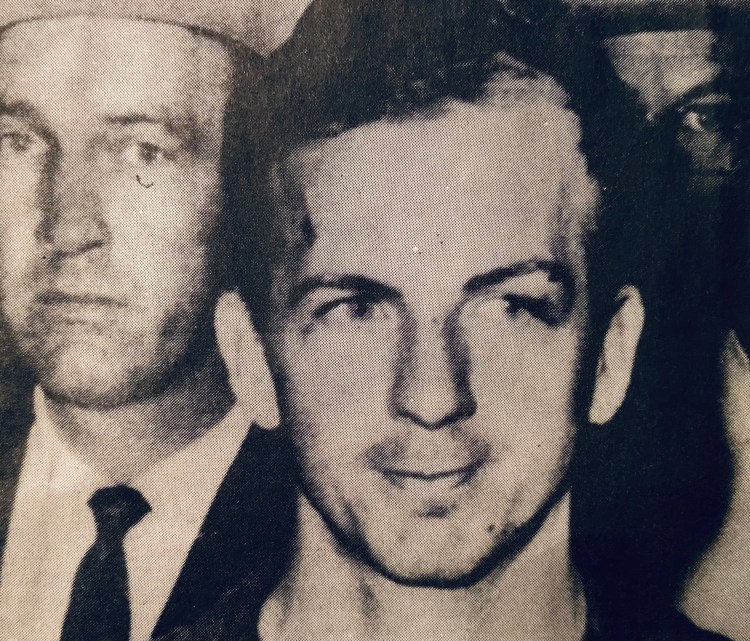
Chronicle. Kristeligt Dagblad. Tuesday, November 30, 1993.
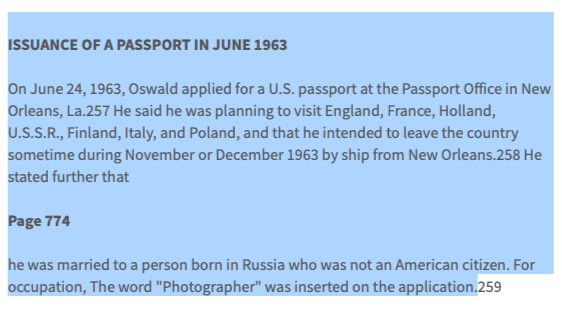
On June 24, 1963, a young American applied for a new passport. As a profession, he wrote ‘photographer’. He planned a trip to Europe, where he would visit several countries. The departure was to take place during November or December of the same year. He would be leaving on a ship from New Orleans.
This young man had arrived in Texas after two and a half years in the Soviet Union. He had returned home with a Russian wife and a young child. He travelled to Dallas in the late summer of 1963, after spending the previous months in the company of some peculiar individuals: right-wing fanatics, mysterious Cubans, and secret agents.
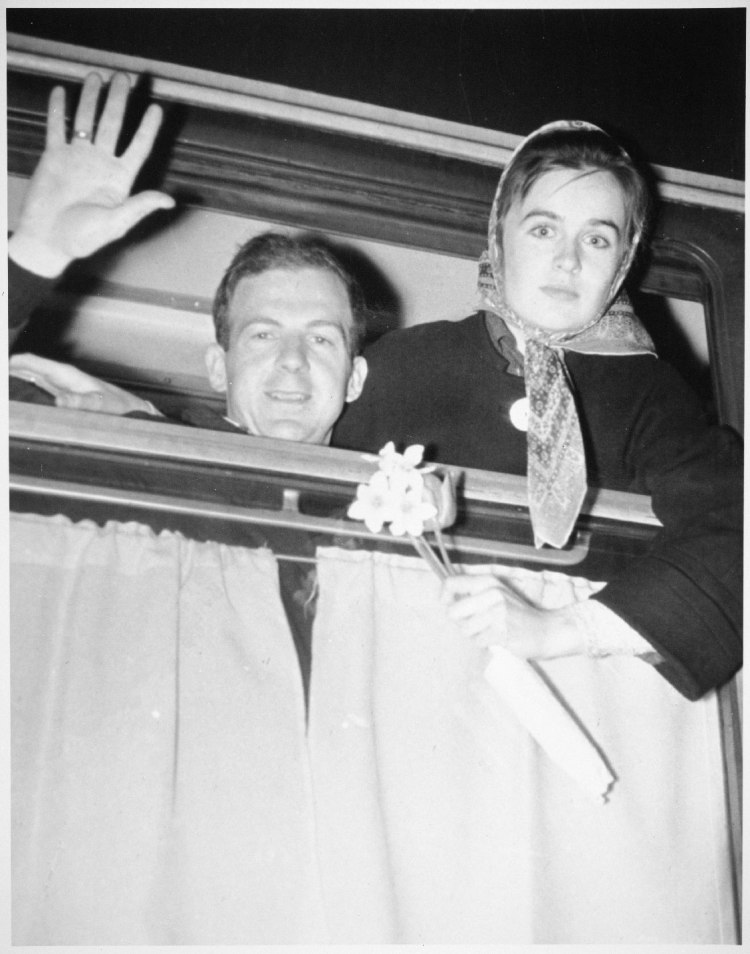
In Dallas, he was arrested. Two days later he was executed — in the basement of the police building. He was a ‘suspect’ in two murders, and declared guilty numerous times on both radio and television. A quiet, intelligent, bookish type who made no secret of his admiration for the president — he was ‘convicted and executed’ within 48 hours. His crime? The most shameful in the history of the United States.
From the moment he was arrested, a tidal wave of incriminating information leaked out. “The suspect’s career has been bizarre,” Peter Kiss wrote in The New York Times. It was rumoured that he had been to Mexico and received money from Cuban agents. He had been seen at shooting ranges (allegedly) and quoted as saying the president should be shot. He was branded a disgruntled loner, an angry young man, a leftist maniac, and the man who had shot John Fitzgerald Kennedy.
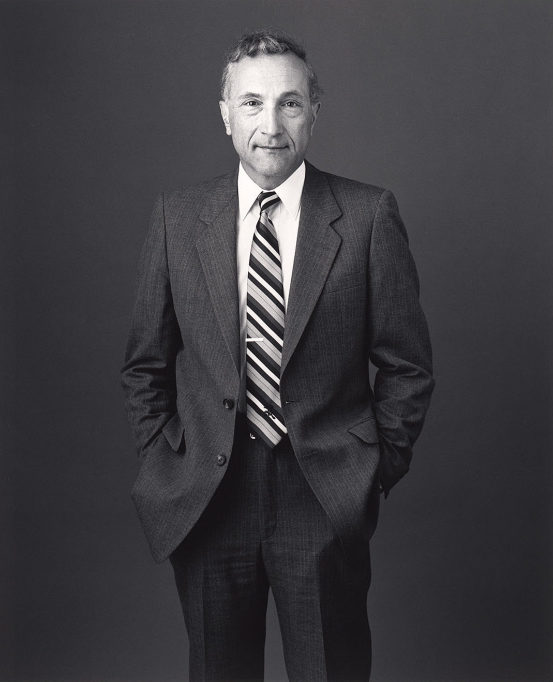
But the conclusion of the investigation, conducted fifteen years later, was that Lee Harvey Oswald had somehow had a connection to the intelligence community. Senator Richard Schweiker, who worked on the Senate Intelligence Committee in the Seventies, said:
“I personally believe that he [Oswald] has a special relationship with one of the intelligence organisations … all the ‘fingerprints’ I found in my eighteen months on the committee indicate that Oswald was a product of, and collaborated with, the intelligence community.”
However, there was a connection, between investigators in Washington pursuing a more productive lead, and further investigation being hampered. After all, understanding Lee Oswald, the person, was only possible if one understood his connections to the hidden world of intelligence activities.
His story begins when he becomes a Marine. He is nicknamed ‘Ozzie Rabbit’, but he quickly proves to be a gifted and bright guy.
He is moved to America’s most secret base: Astugi in Japan. There he learns about the top-secret spy flights over the Soviet Union. After his return to the United States, he studies Russian at a military language school in California.
He is regarded as a serious young man by his fellow students. They notice that he reads neither comics nor cheap paperback novels, only literature. Some are aware that he is in training as an intelligence officer.
Within a month, he leaves the Marine Corps and defects to the Soviet Union. Before leaving, he sends a letter to his mother: “Mom, I’ve made up my mind. I want to travel by ship. I’m going to see a lot and besides, the work is good.”
The work was good, at least Oswald thought it served a good cause. Perhaps not surprising, since at this time the Americans were engaged in a program to expose the Russians to fake “defectors”. The purpose was to judge the Russian response.
We have now reached the summer of 1963, when we find Lee Oswald on the streets of New Orleans, distributing pro-communist literature. He acts as a leftist, communist sympathiser. But in reality, he lives among fanatical anti-communists whose hatred for Fidel Castro, is barely surpassed by their hatred of John F Kennedy. These individuals have connections to the CIA, the FBI, and organised crime, in other words, the mafia. They all considered Kennedy unfit to govern.
John F Kennedy was a man whose policies would give blacks equal rights with whites; and who favoured ‘compromise with the communists’ — the Soviets. He was a man whose brother, as Attorney General, was planning to eradicate the mafia. On top of this, Kennedy was a Catholic. That was more than many in the South could tolerate. Especially in the ‘hate capital’, Dallas.
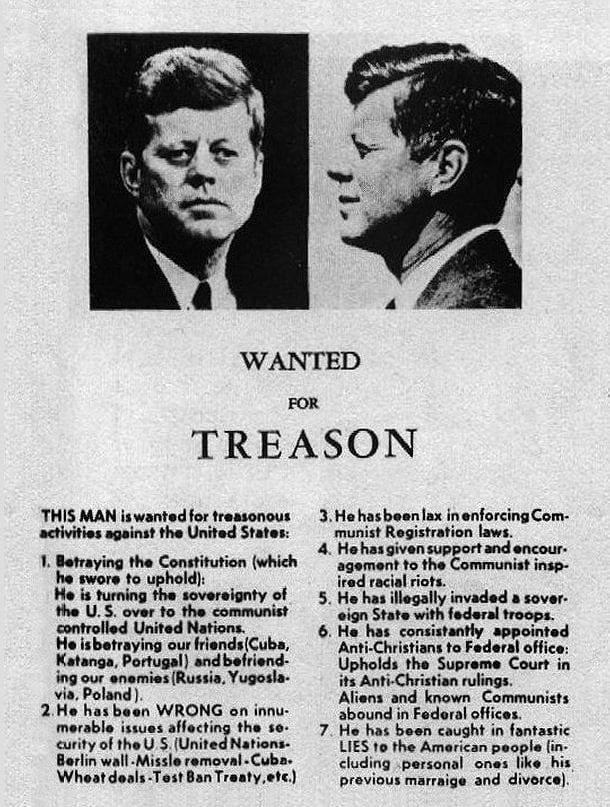
In the days before JFK’s visit, it was not unusual to hear jokes about how the president was to be shot in the city. Many of Kennedy’s friends, and other politicians, pleaded with him not to go on the Dallas trip. But even though Kennedy was not looking forward to the journey south, he was determined to see it through with an election year approaching. He also knew, that if someone really wanted to assassinate him, it would be impossible to stop them. He once remarked that if someone wanted to kill the President of the United States, all they needed was a rifle and a tall building.
During the hectic weekend at the Dallas police station, Oswald managed to say some words to the press. Perhaps most interestingly, and contrary to the later descriptions of him in the Warren Report – as the lone madman who would make his mark in history – he denied any knowledge of the murder.
One of the first things he said to the press was: “I don’t know what kind of reports you people have received, but I categorically deny these accusations.”
Later, when he realises that the authorities really believe he is the culprit, he says: “I’m just a patsy.” I am just a ‘scapegoat’.
Later, after being denied access to a lawyer, he seemed almost pitiful when he said: “I am asking someone to come forward and give me legal aid… I am not a troublemaker; nothing about the president annoyed me… I really don’t know what this case is about.”
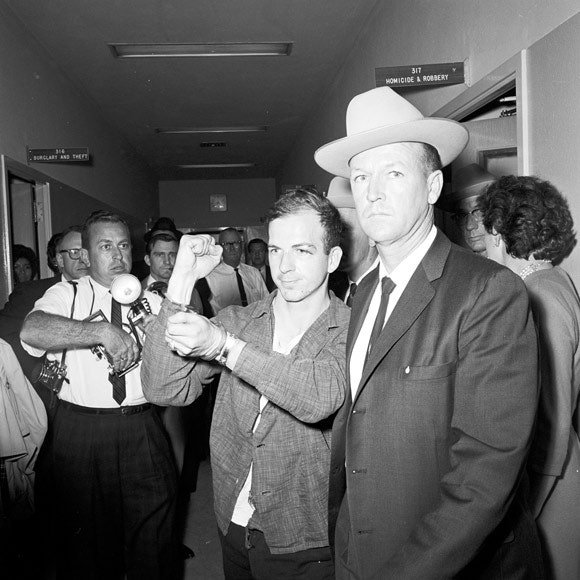
If you choose to believe him, you can perhaps find some support on the few pages of the Warren Report about his interrogation. Incredibly, there is no actual written record. We are meant to believe that the Dallas police station could not provide the necessary equipment to record the conversations! What we do have, though, are first-hand impressions of the police officers and agents who were present during the interrogations.
On closer examination, it turns out that Lee Oswald answered quite honestly, the questions asked about his whereabouts on November 22. The three things he was later accused of lying about were, interestingly enough: 1. The murder weapon 2. The infamous pictures in which he displays himself with weapons and communist propaganda, and 3. The assassination of Kennedy and policeman Tippet, who was shot somewhere between Jack Ruby’s and Oswald’s residence. Subsequent events and revelations on these three points suggest that Oswald was truthful.
However, the convincing evidence that Oswald was probably innocent was discovered as early as the Seventies.
At that time, it was revealed that J Edgar Hoover, the longtime head of the Federal Police, had lied to the Warren Commission from start to finish. The Commission, which had been set up by President Lyndon Johnson, was 100% dependent on the Federal Police, and on the CIA intelligence agency, for their information. Both organisations lied and misled the Commission. That was why, G. Robert Blakey, who headed the second major investigation into Kennedy’s assassination, could say:
“The Warren Commission’s and Federal Police’ explorations of conspiracy were so flawed that their conclusions, that there was no evidence of a conspiracy, could not be taken seriously.”
So, who was this Lee Harvey Oswald? The man who loved dogs as a child and whose greatest desire was to become a Marine?
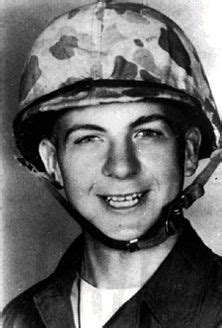
Who was this young man whose fate became so tragic and who came to bear the guilt of an entire nation?
Jack Ruby wasn’t alone in ‘mystifying’ Oswald when he silenced him in the basement of the Dallas PD. What could the information in the Oswald file, that the US Army destroyed in 1973, have told us about him? And what is it that hides in the many classified documents that the public never gets to see?
One thing is certain, though: Lee Oswald was no left-wing maniac. He was neither a loner nor a communist. For reasons still unknown, he had become embroiled in some of history’s most dramatic events. He thought he was going to Europe in the autumn of 1963. Oswald, ’the photographer’, Oswald was ready for the trip. Another ship was awaiting him in the harbour in New Orleans. Federal police found his equipment after his death: four cameras, one a spy camera, two binoculars, a telescope, many rolls of film, some of them exposed, with images from military installations in Europe and Latin America.
It was not until 1978 that it was possible to gain access to this information at the Federal Bureau of Investigation. Jack Ruby, Oswald’s assassin, and who has increasingly proved to be a key figure in the anti-Kennedy conspiracy, hinted at a plot shortly before his death in1967: “Everything related to what happened has never come to light… These people who have so much to gain and who had ulterior motives in getting me in this position, will never allow all the facts to leak out to the world.”
Over the past thirty years, countless pieces of evidence of a conspiracy have leaked out. The conclusions of the three investigations, conducted by Congress and the Senate, (The Church Committee, Rockefeller Commission, and HSCA) were, that there was no basis in the Warren Commission’s claim of no wider conspiracy. Senator Richard Schweiker said in 1978, that:
“One of the greatest cover-ups in the history of our country took place during that time.”
Is it not time that a historical injustice was corrected? When we remember how political violence came to characterise American society in the Sixties, how it traumatised an entire generation — and took some of its most promising leaders — we may feel some sympathy for the man who said: “I really don’t know what this case is about.”
 peteryoung.dk