Scottish independence pamphlet

by C. Stewart Black
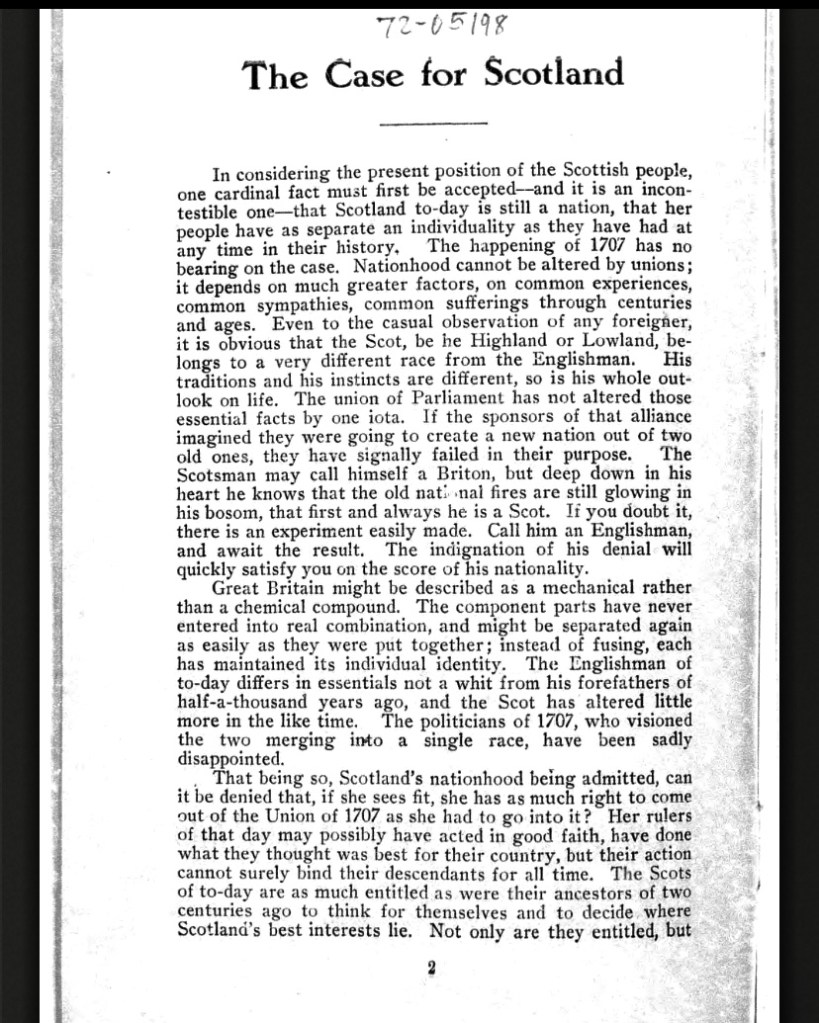
In considering the present position of the Scottish people, one cardinal fact must first be accepted, and it is an incontestable one, that Scotland to-day is still a nation, that her people have as separate an individuality as they have had at any time in their history.
The happening of 1707 has no bearing on the case. Nationhood cannot be altered by unions; it depends on much greater factors, on common experiences, common sympathies, common sufferings through centuries and ages. Even to the casual observation of any foreigner, it is obvious that the Scot, be he Highland or Lowland, belongs to a very different race from the Englishman.
His traditions and his instincts are different, so is his whole outlook on life. The union of Parliament has not altered those essential facts by one iota. If the sponsors of that alliance imagined they were going to create a new nation out of two old ones, they have signally failed in their purpose. The Scotsman may call himself a Briton, but deep down in his heart he knows that the old national fires are still glowing in his bosom, that first and always he is a Scot. If you doubt it, there is an experiment easily made. Call him an Englishman, and await the result. The indignation of his denial will quickly satisfy you on the score of his nationality.
Great Britain might be described as a mechanical rather than a chemical compound. The component parts have never entered into real combination, and might be separated again as easily as they were put together; instead of fusing, each has maintained its individual identity. The Englishman of today differs, in essentials, not a whit from his forefathers, of half a thousand years ago, and the Scot has altered little more, in the like time.
The politicians of 1707, who visioned the two merging into a single race, have been sadly disappointed. That being so, Scotland’s nationhood being admitted, can it be denied that, if she sees fit, she has as much right to come out of the Union of 1707 as she had to go into it?
Her rulers of that day may possibly have acted in good faith, have done what they thought was best for their country, but their action cannot surely bind their descendants for all time. The Scots of today are as much entitled as were their ancestors of two centuries ago to think for themselves and to decide where Scotland’s best interests lie. Not only are they entitled, but they are better able to do so, for they have the experience, of over two hundred years of union, to help them to their decision.
The Union.
Let us consider this Union of 1707. How was it brought about? Did Scotland wish it? Did Scotland gain by it?
The events of 1706, and the years immediately preceding it, are sufficiently notorious to need but little telling here.
Scotland had been reduced to a state of the most acute financial embarrassment, by the failure of the Darien enterprise, a failure largely due to the machinations of William of Orange, who, from a Dutchman, had become so good an Englishman, that he blinded himself to the fact that he was also King of Scots. She, Scotland, was in a condition in which it was possible to impose on her, by political means, what England had always failed to do by force of arms.
Since the beginnings of the two Kingdoms, England had felt that an independent Scotland was a constant menace to her. This distrust had been aggravated by Scotland’s attempts at commercial development, in the later years of the seventeenth century; and it was because of it, that the English, headed by the king, had virtually combined with the Spaniards to ruin the Scottish colony on Darien.
The point, that most seriously agitated the politicians of London, was the question of succession to the throne. England was determined that the Stewarts should never come back. Scotland maintained her right to decide on that matter for herself, and, in 1703, passed an Act of Security, investing the Scots Parliament with the power of choosing, from the royal line, a successor to Queen Anne, on her death. This Act decreed that, unless Scotland were given equal privileges in trade and navigation with England, the Union of the Crowns should be terminated.
A special clause authorised the compulsory military training of every male Scottish subject, so that, if necessary, the country’s independence might be safeguarded with the sword. There was little evidence here of any inclination towards union.
The English retorted with an Act which threatened that, if the Hanoverian Succession were not accepted by Scotland by Christmas 1705, all Scots in England were to be treated as aliens, while the English Navy would prevent all trading, between Scotland and France.
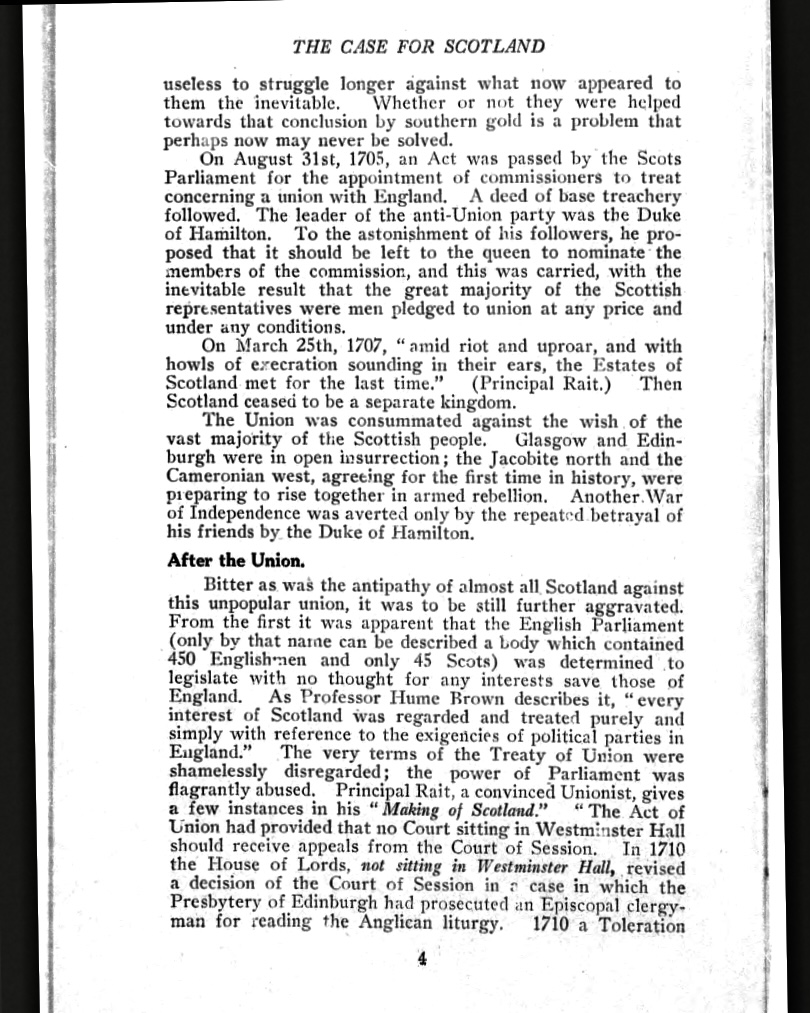
It thus became clear, that England was determined to use every means, fair or foul, to compel her smaller neighbour to submit to being absorbed. To many Scots, it began to appear useless, to struggle longer against what now appeared to them, the inevitable. Whether or not they were helped towards that conclusion by southern gold is a problem that perhaps now may never be solved.
On August 31st, 1705, an Act was passed by the Scots Parliament, for the appointment of commissioners to treat concerning a union with England. A deed of base treachery followed. The leader of the anti-Union party was the Duke of Hamilton. To the astonishment of his followers, he proposed that it should be left to the queen to nominate the members of the commission, and this was carried, with the inevitable result, that the great majority of the Scottish representatives were men pledged to union at any price, and under any conditions.
On March 25th, 1707, “amid riot and uproar, and with howls of execration sounding in their ears, the Estates of Scotland met for the last time. “Then Scotland ceased to be a separate kingdom. The Union was consummated against the wish of the vast majority of the Scottish people. Glasgow and Edinburgh were in open insurrection; the Jacobite north and the Cameronian west, agreeing for the first time in history, were preparing to rise together in armed rebellion. Another War of Independence was averted, only by the repeated betrayal of his friends by the Duke of Hamilton.
After the Union.
Bitter as was the antipathy of almost all Scotland against this unpopular union, it was to be still further aggravated. From the first it was apparent that the English Parliament, only by that name can be described a body which contained 450 Englishmen and only 45 Scots, was determined to legislate with no thought for any interests save those of England.
As Professor Hume Brown describes it, ‘every interest of Scotland was regarded and treated, purely and simply, with reference to the exigencies of political parties in England. ’The very terms of the Treaty of Union were shamelessly, disregarded; the power of Parliament was flagrantly abused. Principal Rait, a convinced Unionist, gives a few instances in his ‘Making of Scotland.’ “The Act of Union had provided, that no Court sitting in Westminster Hall should receive appeals from the Court of Session. In 1710, the House of Lords, not sitting in Westminster Hall, revised a decision of the Court of Session in a case in which the Presbytery of Edinburgh had prosecuted an Episcopal clergy-man for reading the Anglican liturgy.
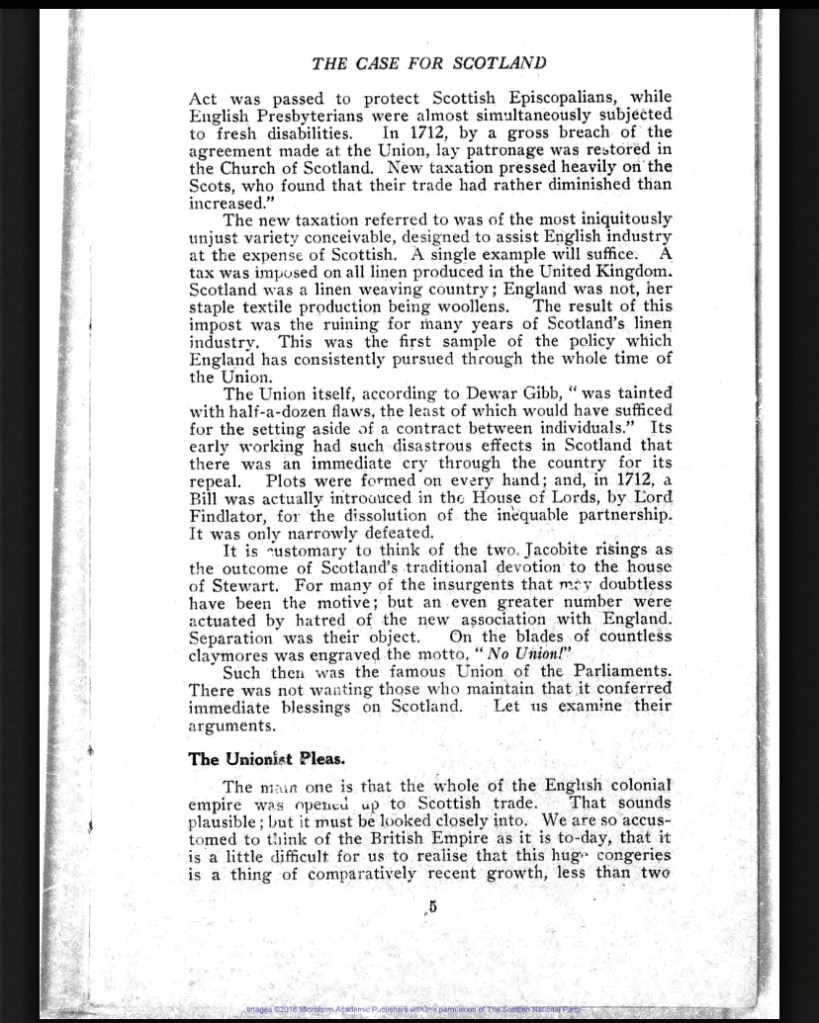
1710, a Toleration Act was passed to protect Scottish Episcopalians, while English Presbyterians were almost simultaneously subjected to fresh disabilities. In 1712, by a gross breach of the agreement made at the Union, lay patronage was restored in the Church of Scotland. New taxation pressed heavily on the Scots, who found that their trade had rather diminished, than increased.
The new taxation referred to, was of the most iniquitously, unjust variety conceivable, designed to assist English industry, at the expense of Scottish. A single example will suffice. A tax was imposed on all linen produced in the United Kingdom. Scotland was a linen weaving country; England was not, her staple textile production being woollens. The result of this impost, was the ruining for many years, of Scotland’s linen industry. This was the first sample of the policy, which England has consistently pursued, through the whole time of the Union.
The Union itself, according to Dewar Gibb, “was tainted with half-a-dozen flaws, the least of which would have sufficed for the setting aside of a contract between individuals.” Its early working, had such disastrous effects in Scotland, that there was an immediate cry through the country for its repeal. Plots were formed on every hand; and, in 1712, a Bill was actually introduced in the House of Lords, by Lord Findlator, for the dissolution of the inequable partnership. It was only narrowly defeated.
It is customary, to think of the two Jacobite risings, as the outcome of Scotland’s traditional devotion to the house of Stewart. For many of the insurgents, that may doubtless have been the motive; but an even greater number were actuated by hatred of the new association with England. Separation was their object. On the blades of countless claymores was engraved the motto, ‘No Union!’.
Such then, was the famous Union of the Parliaments. There was not wanting those who maintain that it conferred immediate blessings on Scotland. Let us examine their arguments.
The Unionist Pleas.
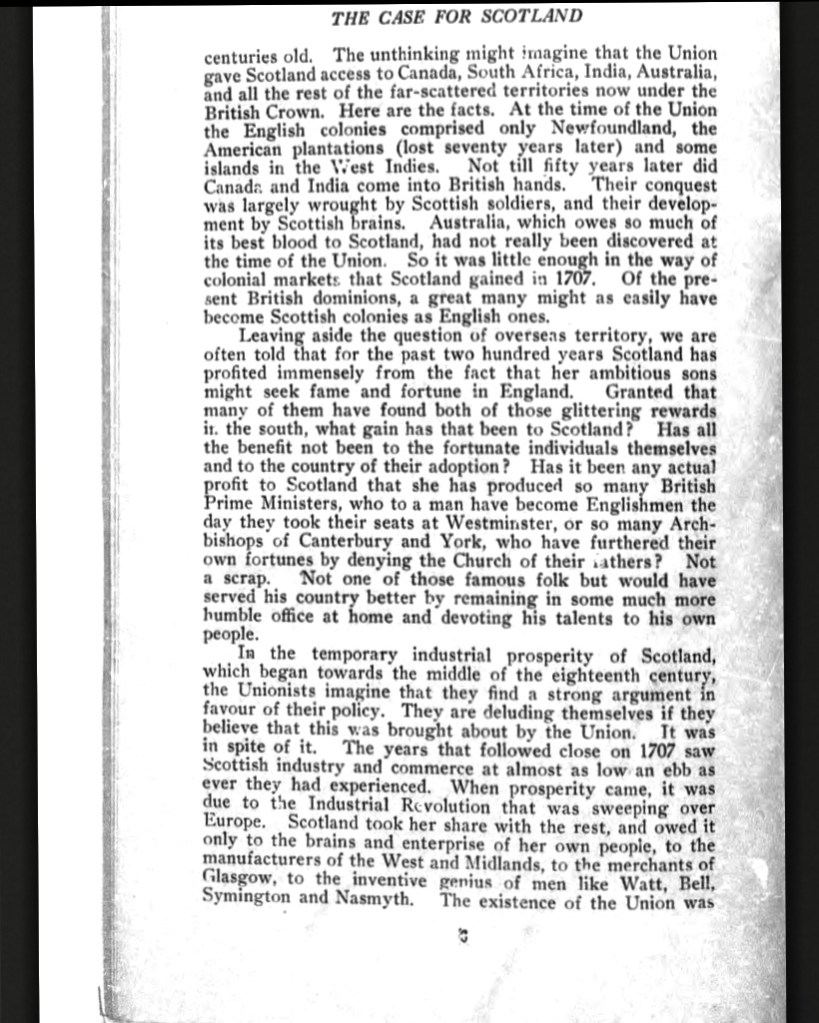
The main one, is that the whole of the English colonial empire was opened up to Scottish trade. That sounds plausible; but it must be looked closely into. We are so accustomed to think of the British Empire, as it is today, that it is a little difficult for us to realise that this huge congeries is a thing of comparatively recent growth, less than two centuries old. The unthinking might imagine that the Union gave Scotland access to Canada, South Africa, India, Australia, and all the rest of the far-scattered territories now under the British Crown. Here are the facts. At the time of the Union the English colonies comprised only Newfoundland, the American plantations (lost seventy years later) and some islands in the West Indies. Not till fifty years later did Canada and India come into British hands.
Their conquest was largely wrought by Scottish soldiers, and their development by Scottish brains. Australia, which owes so much of its best blood to Scotland, had not really been discovered at the time of the Union. So it was little enough in the way of colonial markets that Scotland gained in 1707. Of the present British dominions, a great many might as easily have become Scottish colonies as English ones.
Leaving aside the question of overseas territory, we are often told that for the past two hundred years Scotland has profited immensely from the fact that her ambitious sons might seek fame and fortune in England. Granted that many of them have found both of those glittering rewards in the south, what gain has that been to Scotland? Has all the benefit not been to the fortunate individuals themselves and to the country of their adoption? Has it been any actual profit to Scotland that she has produced so many British Prime Ministers, who to a man have become Englishmen the day they took their seats at Westminster, or so many Archbishops of Canterbury and York, who have furthered their own fortunes by denying the Church of their fathers? Not a scrap. Not one of those famous folk but would have served his country better by remaining in some much more humble office at home and devoting his talents to his own people.
In the temporary industrial prosperity of Scotland, which began towards the middle of the eighteenth century, the Unionists imagine that they find a strong argument in favour of their policy. They are deluding themselves if they believe that this was brought about by the Union. It was in spite of it.
The years that followed close on 1707 saw Scottish industry and commerce at almost as low an ebb as ever they had experienced. When prosperity came, it was due to the Industrial Revolution that was sweeping over Europe. Scotland took her share with the rest, and owed it only to the brains and enterprise of her own people, to the manufacturers of the West and Midlands, to the merchants of Glasgow, to the inventive genius of men like Watt, Bell, Symington and Nasmyth.
The existence of the Union was no more than a coincidence, and one that almost certainly did more harm than good. Without it, such men as Watt and Nasmyth would, in all likelihood, have remained in Scotland, to develop industry there, instead of building up English wealth with Scottish brains. These, then, are the benefits that are claimed to have come with the Union, a very easily exploded claim, for not a single one of them is genuine. One thing, however, Scotland did owe directly to the early labours of the Westminster Parliament, one that is carefully ignored by the Union apologists — two centuries of bitter sectarian strife from which only now is she gradually recovering.
Patronage in the Church of Scotland has been abolished before the end of the seventeenth century. It was restored by her English rulers in 1712, with what sad results it is only too well known. The Church was riven into a score of sects, brotherly love was forgotten in an orgy of ecclesiastical hatred. If this was a benefit, then the Union was a success.
What Scotland Lost.
Let us turn to the other side of the balance sheet. What did Scotland lose in 1707?
The moral loss cannot be calculated, but that it was very great can scarcely be denied. For an ancient people, once with their destinies in their own hands, to become merely the inhabitants of a little-considered province, was a change that can have wrought nothing but degeneration in moral fibre.
Her other losses are more easily estimated. First there was her Parliament. There is a custom to speak slightingly of the Scottish Assembly, and to forget the fact that some years before the Union, it had become a real deliberative and legislative body, with a constitution better than the English one. And even in earlier times, was it a worse fate for a country to be governed by “Lords of the Articles”, rather than by a party of caucus and dictatorial Cabinet as has so long been the fate of England and Britain?
A system must be judged by its results. The Scots Parliament, under both its earlier and its later constitutions, produced laws that, for general equity, may safely be compared with those of any other national assembly of its time.
In place of her own legislative body, Scotland was given a share in an assembly, to which she contributed only forty-five members out of five hundred. However gallant a band those forty-five may have been, what could they possibly do when a solid phalanx of four hundred and fifty was ranged against them? Nothing. Scotland had virtually no part in the government of the United Kingdom. Even her own purely. personal affairs were decided by the hugely preponderating majority of Englishmen.
Scotland entered the Union with a system of law generally accepted by the greatest authorities as superior to the English one. In the Treaty special provision was made for its preservation; yet the ink of the signatories was scarcely dry on the paper before the London Parliament had begun to twist and contort the Scottish system into an approximation to the English, a process that has been maintained almost continuously ever since, with results that have rarely been in the interests of justice.
In “Scotland in Eclipse”, Mr. Dewar Gibb, an admitted authority on both Scots and English law, devotes a long chapter to this interesting and important topic. A single example will perhaps suffice here.
Long before the Union Scotland had discarded the practice of jury trial in civil cases. “That farcial engine of injustice,” as Mr. Gibb terms it, had been recognised to be too open to abuse to produce fair plav between litigants.
The average juryman is too inexperienced in weighing evidence and too susceptible to mawkish sentimentalism and persuasive blandishment, so Scots civil law dispensed with his services. There are few legal experts but will agree that this was a wise step.
In England, however, trial by jury has always been a fetish; so the English members of Parliament, early in the nineteenth century. decided that Scottish litigants must have their juries too, and the Scottish courts were thrust back into the toils of a pernicious system which they had discarded more than a century before.
Not only was the Law of Scotland tampered with as the result of the Union, but it has been continuously over-ridden. Within three years of the signing of the Treaty, the House of Lords had assumed the illegal function of hearing appeals against the decisions of the Court of Session. That infringement of Scottish rights has continued with steadily increasing frequency.
The findings of the highest court in Scotland are regularly overturned by men who know nothing whatever of Scots Law, and care as little. Even now, when Scottish judges are included on the bench of the House of Lords, there is always a majority of Englishmen, whose decisions are based solely on English practice, and the law of Scotland, famous for the administration of equity, is set aside in favour of an alien code that is foreign both to Scottish tradition and to Scottish ideas of justice.
The notorious Free Church case is too well-known to need recounting here. It is by no means an isolated example of the result of English domination. Similar cases might be cited by the score.
When she was an independent state, Scotland had her own representatives in the various foreign countries with which she had commercial relations. With the Union they disappeared. The loss was much greater than might at first thought be apparent. In place of them, Scotland has now, to share the consular services of the men who represented England, men who first thought, perhaps not unnaturally, was for their own country. Scottish interests were never a first consideration, and very seldom even an early one. Scots manufacturers today are painfully aware how faithfully this
consular tradition of “England always first ” is still carried on. So are those who have been trying to bring to the notice of foreigners, and of the colonies, the advantages of Glasgow and other Scottish ports as distributing centres for Britain. They have had to fight not only the apathy but the active opposition of those who are supposed to represent Scotland as well as the other parts of the United Kingdom.
A poor bargain for Scotland was this much vaunted Union. Even the men who engineered it, in face of the strenuous opposition of nine-tenths of their countrymen, must have realised within half-a-dozen years that if they had not been knaves they had at least been fools.
The Position Today.
All that, of course, was two hundred years ago, and it does not follow that what was bad then must necessarily be equally bad now, or indeed bad at all.
That will readily be admitted. We must enquire into conditions today. Has Scotland begun to prosper? Has England ceased to be the domineering tyrant, and realised that her poor kinsman of the north is something better than a conquered slave or a quite negligible member of the commonwealth? The first question is, unfortunately, only too easily answered. The census figures-(1931) supply the information. The population of England has increased at a normal rate. That of Scotland has actually gone considerably down, a happening that has no precedent since first censuses were taken in Britain. There is little evidence of prosperity there. And the reason lies in the negative answer that must be given to the second question.
Scotland is a decaying country as the result of England’s failure to obey the spirit of the Union, of Englands grasping greed, of Englands refusal to consider for a moment the claims of Scottish interests.
This is a quite astonishing state of affairs, for there is no country in the world more magnanimous than England can be when she cares. She has shouldered the debts of her allies in war; she has sacrificed untold millions in setting all manner of foreign states on their feet. But where Scotland is concerned, Scotland who has given her best blood for her on a hundred battlefields, she is a soulless tyrant, a selfish miser.
“Scotland is the milch cow of the Empire,” Lord Rosebery once declared. Were he alive to-day, he might carry his metaphor further. The cow is going yeld, so she is on her way to the slaughter-house.
From the beginning Scotland has accepted the full responsibility of her position as a member of the United Kingdom; she has submerged her own individuality, and “played the game.” England has never made the slightest attempt to do likewise. We must do her the justice of admitting that neither has she ever pretended to do it. She has been perfectly frank in her attitude. To her, Britain does not exist; it is some imaginary place, a delusion to which Scotsmen have an absurd attachment, the misguided idiots!
This island of ours is England, ruled by the English king and the English parliament, its shores guarded by the English navy under the English flag, with the help of the English army. Those Scots and Welsh are tiresome nuisances, with their continual prating about Britain. What are they, anyhow? Poor insignificant creatures, who should be humbly grateful if they are accepted as Englishman! That is the Englishman’s faith, and he is proud of it. He believes every word of it. Modestly suggest to him that it was a Scot who led the British armies to victory in 1918, that it was another who received the surrender of the German Battle Fleet, and that half-a-million other Scots had more than a little to do with the winning of the War, and he will bestow a condescending smile of commiseration on your foolish obsession Scotland and Wales are mere geographical terms. Ireland was an incubus that has been got rid of. Only England matters; only England really exists.
There is much to be said for the Englishman’s megalomania. It has put his country into the leading position which she occupies in the world today. But it makes him a very bad member of an international partnership. It was the cause of all the woes of Ireland, and it is the cause of Scotland’s present peril.
England, unless in the days of the vicious Cromwell, did not on the whole treat Ireland badly. She was even generous to her. But she felt that she had a heaven-sent mission to ‘manage’ Ireland, in spite of Ireland’s conviction that she was quite well able to do so herself. The result was the deplorable muddle, the ages of hatred and bloodshed that now, happily, have passed away with the restoration of Irish independence.
With Scotland, the English method has been different. There has been no generosity. Scotland has never been treated as the capricious child that Ireland was, but always as a rather troublesome adult, one requiring to be kept in place. For her to seek equality in the partnership of the United Kingdom was the veriest presumption. The suggestion was not for a moment to be entertained.
Since 1707 it has been Scotland’s part to pay her taxes and keep quiet, contenting herself with such scraps as might fall from the over-flow of England’s well-heaped table. The Englishman will deny that: but there are facts and figures in plenty to prove it. Scotland has poured her contributions faithfully, year after year, into the Imperial exchequer, and only a scanty share has ever come back to her for use in her own purposes. The balance has been a contribution to England, a greater burden of tribute than any vanquished nation has ever paid to her conqueror. Yet Scotland was never conquered; she was made to believe she was entering into a partnership. It is a strange partnership in which one member gets all the kicks and the other all the ha’pennies.
It was foolish of Scotland ever to have imagined that things could be different. Equality between two nations of such unequal size is essentially impossible.. To suggest that Scotland should have as many representatives as England in their joint parliament would be absurd. Representation must be, at least approximately, in proportion to population. That makes it impossible for Scotland to have sufficient members of parliament at Westminster to prevent their being swamped by the necessarily huge majority of Englishmen. So long as there is a joint assembly, the policy of the country, including the government of Scotland, must be dictated by the English majority, on whose intelligence and goodwill Scotland must be entirely dependent.
At Westminster to-day, Scotland has 74 members in a total of 615. Those figures speak for themselves. No Scottish measure, promoted by the Scottish members, can be carried in the face of English opposition. Times without number that has been demonstrated. For example, during recent years there have been introduced a series of Bills to grant Scottish Home Rule. Not one of them failed to secure a majority among the Scottish members; but each was hustled out of the House by the Englishmen.
Where our money goes.
The English are firm believers in the creed that charity begins at home; and they follow it faithfully in the administration of the Imperial purse.
When money is to be spent, it is better spent in England than anywhere else. We may blame their policy, but we need not profess to be surprised at it, for it is only human nature after all. Any other nation, with the same power and opportunity, would probably act in the same way. It is Scotland’s misfortune, not England’s fault, that in the unequal alliance she is the smaller partner, and a dear misfortune it is indeed. It has cost her incalculable millions.
For ten years back, the British governments, of whatever party, have consistently refused to publish a separate return of Scottish revenue and expenditure, although it has been asked for time and again. It used to be done. The last statement issued was for the vear 1920-21. In that financial year Scotland contributed in taxes to the Imperial exchequer the sum of £119,753,000.
Of that she received back, for services in Scotland, only £33,095,000. The remainder was spent elsewhere, mostly in England. That remainder amounted to the colossal sum of €86,658,000. These are staggering figures, almost unbelievable. But they are true. We have them on the word of the Government actuaries.
Though the figures for more recent vears are not available, it may quite safely be assumed that they have not improved from Scotland’s point of view.
Where does the money go? In a hundred and one directions. Let us consider a few of them.
There is the upkeep of the Imperial Forces. That costs many millions of pounds each year, but very, very little of the sum is spent in Scotland, although Scotland pays her due proportion of it in taxation, and is entitled to have a fair share of it come back to her.
Take the Royal Navy. It has come to be regarded as a purely English service. There are English ports that are swarming all the time with battleships, while the Clyde and the Forth have to be content with the fleeting visit of an occasional destroyer or at best a light cruiser.
Scotland actually sees less of the Fleet than does many a little island in the West Indies, and less of the Fleet’s money which she has helped to provide.
There is no strategic reason for this neglect of our country by the Navy which is partly ours. Quite the reverse. The War showed that the safest and most effective base for the British Battle Fleet was in the mouth of the Forth, at Rosyth. A huge dockyard was constructed there. When the war was over, what happened? Retrenchment was the cry. Money must be saved, come what might. The Government decided that a naval dockyard must be closed down; and which, think you, was sacrificed? The one that was Britain’s fighting base during the late war, and would almost certainly be her base again if ever another war should come — Rosyth.
No reason for this choice was given by the autocrats at White-hall, but there could be only one thing that influenced them, the fact that Rosvth was in Scotland. Its material and strategic advantages were ignored; so was the war efficiency of the Navy; the only thing that mattered was the keeping in employment of English workmen and English Admiralty contractors. It would have been unthinkable for them to have closed down a base in the south, so long as there was one in Scotland that might be scrapped.
The Scottish members of parliament, of every party, protested vehemently against the closing of the dockyard on the Forth, but all in vain. The Government was adamant. They attempted feebly to justify themselves by saying that only a beginning had been made. Chatham was shortly to follow Rosvth. That was almost ten years ago, but there is no sign of Chatham going yet, and there is not likely to be.
The selfish policy of the English Admiralty (it cannot be styled British) has not ended there. When a restriction of armaments was decided on, it was necessary to cancel the building of a number of warships which had been previously ordered. The blow fell first on Beardmore’s yard, on the Clyde, the only Scottish firm holding a contract. Some time later certain English orders were cancelled also. The hardship on the firms then involved was considerably lessened by giving them other work in place of what had been taken away. No such considerate treatment was afforded to the Clyde.
A good deal of repair work to naval ships was formerly done in Scotland. The Admiralty has now declared that in future this must all be done in the Government dockyards, all of which are in England. The Clyde, which build the best ships in the world, and has created in the past some of the finest units of the British Navy, has little chance of ever seeing a battleship on the stocks or in dock again, unless the dire necessity of war compels it.
As with the Navy, so also with the Army. Scotland pays for the upkeep of an eighth part of our land forces. Do we ever have anything approaching that number of troops stationed here? At most we have a battalion in Edinburgh and one in Glasgow, and a few small, very small, depots in some other towns. The depot of Scotland’s only cavalry regiment is now actually in England. Where are the remainder of our troops? Some are overseas; that cannot be complained of. The rest are in England, spending their money, which we pay, in English shops, having their food and clothing and housing, which we pay for, provided by English contractors.
In the Royal Air Force things are no better. The money spent locally in maintaining the detachment at Leuchers in no way corresponds to Scotland’s contribution towards the upkeep of the air service.
Even worse, perhaps, than the scandal of the Army and Navy is that of the Civil Service, although the sum of money involved may not be so great. The thing called the Scottish Office is situated in London. The staff consists largely of Englishmen, and every penny of their salaries goes into English pockets.
How we are swindled.
In the administration of the huge amount of money devoted to social services, Scotland is swindled every day. She contributes the same proportion of it, man for man, as England does. In most cases she is much more in need of it than is the luckier south. Yet every year she is defrauded of millions of what she pays. Let me give but a few examples of how it is done.
The rate of unemployment is considerably higher in Scotland than in England. At present it is actually twice as high as that of south-eastern England, including London. Scotland was entitled to expect fair treatment under Mr. J. H. Thomas’s schemes for unemployment relief. Here is what she received.
In July, 1929, in answer to a question in the House of Commons, Mr. Thomas stated that a total of £5.5 million pounds had been allocated, England had received £5,000,000, Wales £416,000, Scotland a paltry £81,000. Wales, with less than half the population of Scotland, had received more than five times as much money. In proportion, she received twelve times the benefit that Scotland did.
By the time that Mr. Thomas quitted office, 221 millions had been disbursed by him. England and Wales had received 21 millions, Scotland 11 millions. In proportion to her population and her contributions to the Treasury, Scotland’s share should have been 21 millions. She was therefore deliberately swindled out of £1,250,000, money which she had herself contributed in taxes.
The Trade Facilities Act was passed for the purpose of giving assistance, by guaranteed loans, to industries that were striving to reinstate themselves after the War, and to undertake useful development. Figures are not available as to the distribution between England and Scotland of the money involved; but one fact is notorious. Time and again, the facilities of the Act were employed to give the South a subsidised advantage over the North. Several millions of pounds, for example, were provided for the Welsh coalfields. Nothing came to Lanarkshire, where the distress was at least as great. That, of course, was only in keeping with the whole policy of our Government towards the Scots mining industry, as witness their action during the wages and hours dispute of the summer of 1931.
The authority of Westminster was used to overturn and agreement made in their own country by Scottish coal-owners’ and miners’ representatives, the admitted reason being that this agreement would have given the Scottish mines an advantage over their English competitors. In consequence, the Scottish employers and workmen had to come to terms that were really satisfactory to neither of them.
One of the most flagrant injustices wrought under the Trade Facilities Act was in connection with the production of steel. In Lanarkshire and the Scottish Midlands there was ample and well-equipped plant, crying out for work. Yet the Government guaranteed a million pounds for the erection of a new and unnecessary steel-rolling mill at Appleby, in England. Soon afterwards the large Mossend Mill, in Lanarkshire, had to close down.
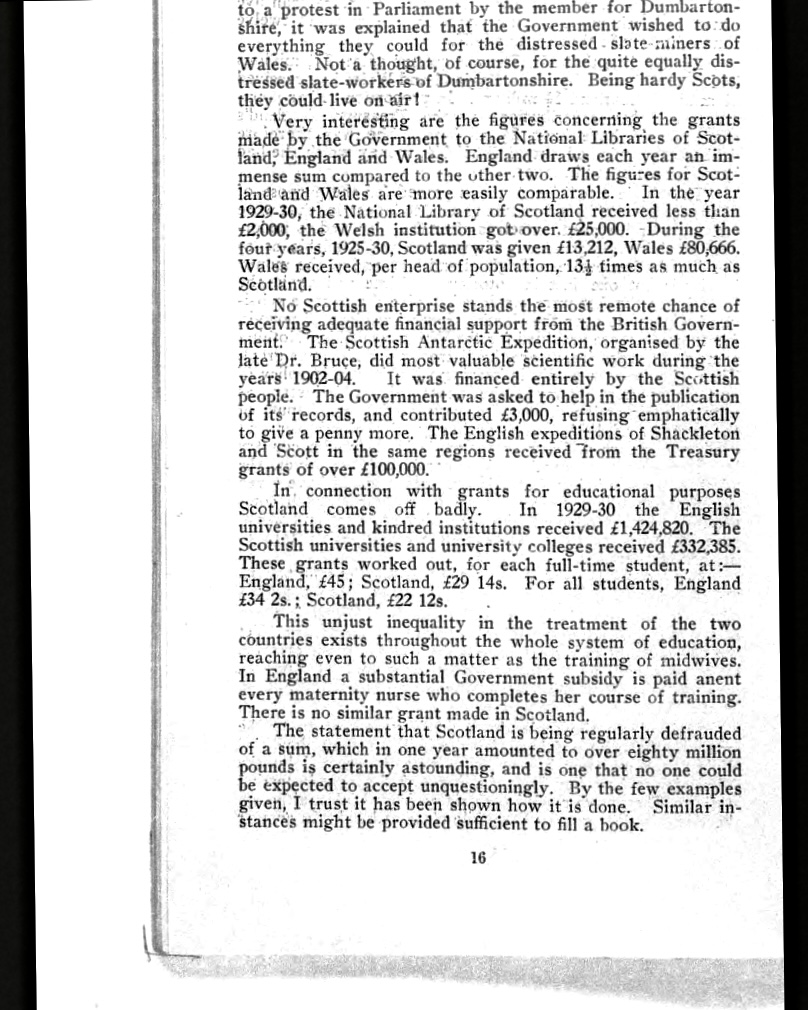
Right down the scale, from the largest concern to the smallest, the same unfair preference is given to England and Wales. Some new houses were recently erected by the Admiralty at Arrochar, in connection with the torpedo-testing station. They were roofed with slates from Wales, although there was a slate quarry lying idle close at hand. In answer to, a protest in Parliament by the member for Dumbartonshire, it was explained that the Government wished to, do everything they could for the distressed — slate-miners of Wales. Not a thought, of course, for the quite equally distressed slate-workers of Dumbartonshire. Being hardy Scots, they could-live on air!
Very interesting are the figures concerning, the grants made by the Government to the National Libraries of Scotland, England and Wales. England draws each year an immense sum compared to the other two. The figures for Scotland and Wales are more easily comparable. In the year 1929-30, the National Library of Scotland received less than £2,000; the Welsh institution got over. £25,000. During the four years, 1925-30, Scotland was given £13,212, Wales £80,666. Wales received, per head of population, 13 and a half times as much as Scotland.
No Scottish enterprise, stands the most remote chance, of receiving adequate financial support from the British Government. The Scottish Antarctic Expedition, organised by the late Dr. Bruce, did most valuable scientific work during the years 1902-04. It was financed entirely by the Scottish people. The Government was asked to help in the publication of its records, and contributed £3,000, refusing emphatically to give a penny more. The English expeditions of Shackleton and Scott, in the same regions, received from the Treasury grants of over £100,000.
In connection with grants for educational purposes Scotland, comes off badly. In 1929-30, the English universities and kindred institutions received £1,424,820. The Scottish universities and university colleges received £332,385. These grants worked out, for each full-time student, at: England, £45; Scotland, £29 and 14 shillings. For all students, England £34 and 2 shillings.; Scotland, £22 and 12 shillings.
This unjust inequality in the treatment of the two countries exists throughout the whole system of education, reaching even to such a matter as the training of midwives. In England a substantial Government subsidy is paid anent every maternity nurse who completes her course of training. There is no similar grant made in Scotland.
The statement that Scotland is being regularly defrauded of a sum, which in one year, amounted to over eighty million pounds is certainly astounding, and is one that no one could be expected to accept unquestioningly. By the few examples given, I trust it has been shown how it is done. Similar instances might be provided sufficient to fill a book.
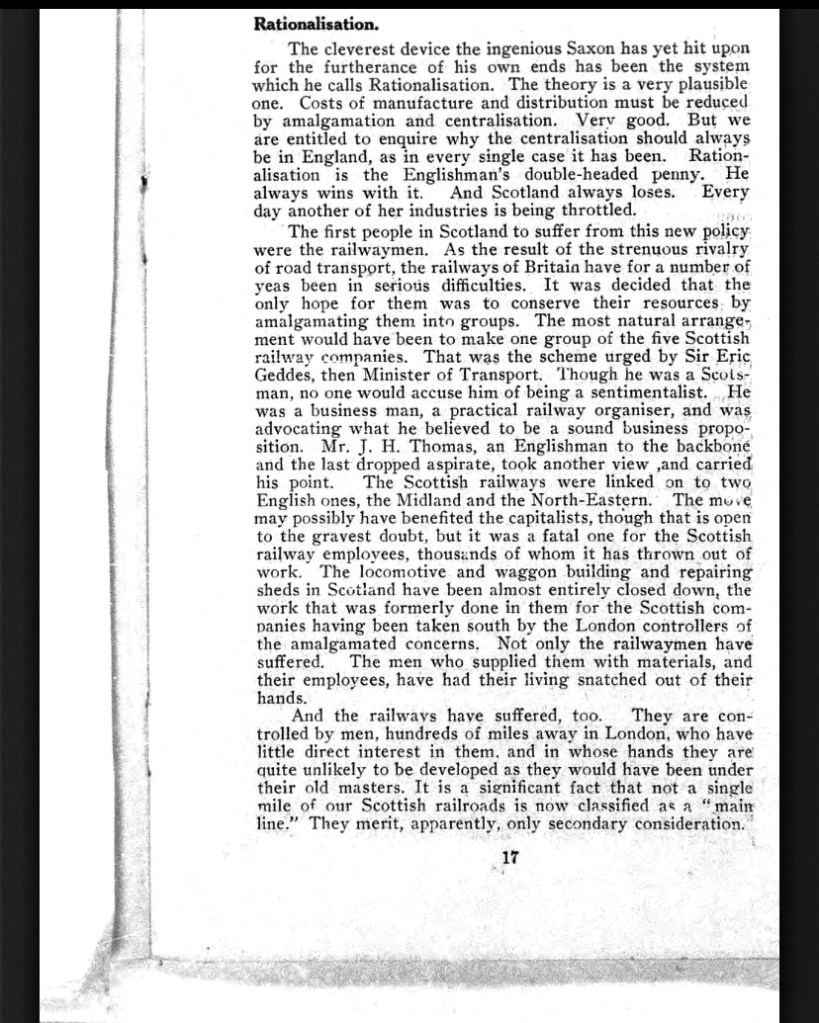
Rationalisation.
The cleverest device the ingenious Saxon has yet hit upon, for the furtherance of his own ends, has been the system which he calls Rationalisation. The theory is a very plausible one. Costs of manufacture and distribution must be reduced by amalgamation and centralisation. Very good. But we are entitled to enquire why the centralisation should always be in England, as in every single case it has been.
Rationalisation is the Englishman’s double-headed penny. He always wins with it. And Scotland always loses. Every day another of her industries is being throttled.
The first people in Scotland, to suffer from this new policy, were the railwaymen. As the result of the strenuous rivalry of road transport, the railways of Britain have, for a number of years, been in serious difficulties. It was decided, that the only hope for them, was to conserve their resources by amalgamating them into groups. The most natural arrangement, would have been to make one group, of the five Scottish railway companies. That was the scheme urged by Sir Eric Geddes, then Minister of Transport. Though he was a Scotsman, no one would accuse him of being a sentimentalist.
He was a business man, a practical railway organiser, and was advocating what he believed to be a sound business proposition. Mr. J. H. Thomas, an Englishman to the backbone, and the last dropped aspirate, took another view, and carried his point.
The Scottish railways were linked on to two English ones, the Midland and the North-Eastern. The move may possibly have benefited the capitalists, though that is open to the gravest doubt, but it was a fatal one for the Scottish railway employees, thousands of whom it has thrown out of work.
The locomotive and waggon building, and repairing sheds in Scotland, have been almost entirely closed down, the work that was formerly done in them for the Scottish companies having been taken south, by the London controllers of the amalgamated concerns. Not only the railwaymen have suffered. The men who supplied them with materials, and their employees, have had their living snatched out of their hands.
And the railways have suffered, too. They are controlled by men, hundreds of miles away in London, who have little direct interest in them, and in whose hands they are quite unlikely to be developed, as they would have been under their old masters. It is a significant fact, that not a single mile of our Scottish railroads is now classified as a “main line.” They merit, apparently, only secondary consideration.
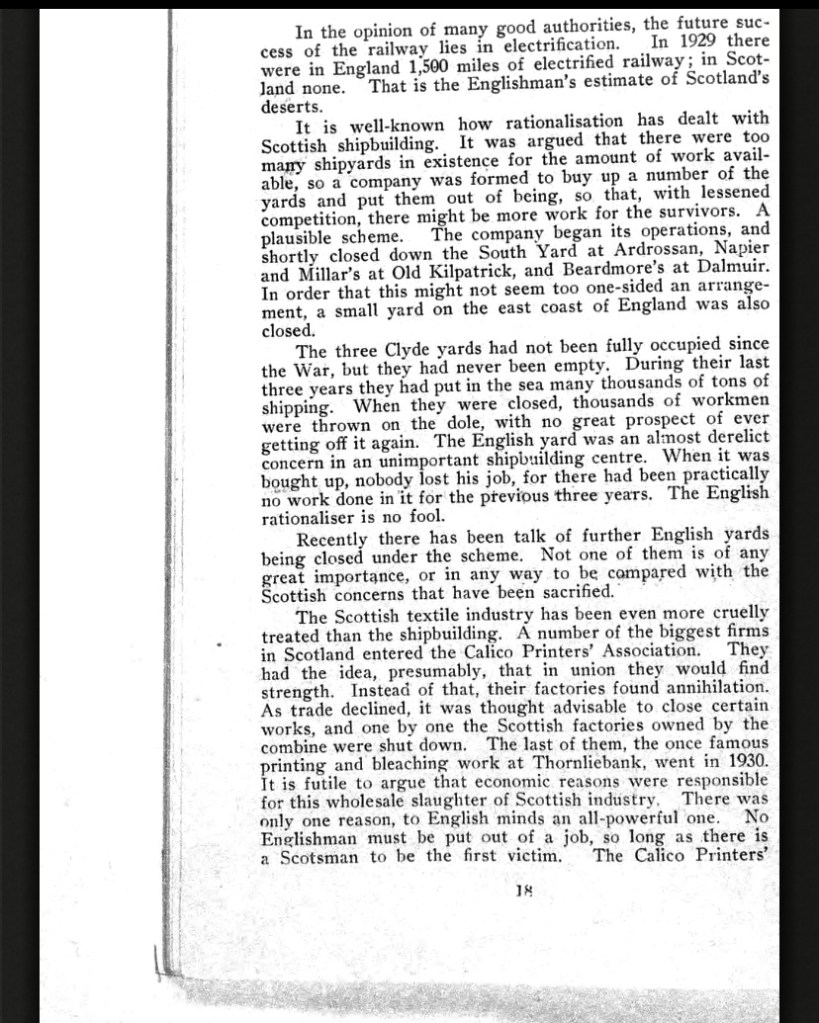
In the opinion of many good authorities, the future success of the railway lies in electrification. In 1929 there were in England 1,500 miles of electrified railway; in Scotland none. That is the Englishman’s estimate of Scotland’s deserts.
It is well-known how rationalisation has dealt with Scottish shipbuilding. It was argued, that there were too marry shipyards in existence, for the amount of work available, so a company was formed to buy up a number of the yards and put them out of being, so that, with lessened competition, there might be more work for the survivors. A plausible scheme. The company began its operations, and shortly closed down the South Yard at Ardrossan, Napier and Millar’s at Old Kilpatrick, and Beardmore’s at Dalmuir. In order that this might not seem too one-sided, an arrangement, a small yard on the east coast of England was also closed.
The three Clyde yards had not been fully occupied since the War, but they had never been empty. During their last three years, they had put in the sea many thousands of tons of shipping. When they were closed, thousands of workmen were thrown on the dole, with no great prospect of ever getting off it again. The English yard was an almost derelict concern in an unimportant shipbuilding centre. When it was bought up, nobody lost his job, for there had been practically no work done in it for the previous three years. The English rationaliser is no fool.
Recently there has been talk of further English yards being closed under the scheme. Not one of them is of any great importance, or in any way to be compared, with the Scottish concerns that have been sacrificed.
The Scottish textile industry, has been even more cruelly treated than the shipbuilding. A number of the biggest firms in Scotland entered the Calico Printers’ Association. They had the idea, presumably, that in union they would find strength. Instead of that, their factories found annihilation.
As trade declined, it was thought advisable to close certain works, and, one by one, the Scottish factories owned by the combine were shut down. The last of them, the once famous printing and bleaching work at Thornliebank, went in 1930.
It is futile to argue that economic reasons were responsible for this wholesale slaughter of Scottish industry. There was only one reason, to English minds, an all-powerful one. No Englishman must be put out of a job, so long as there is Scotsman to be the first victim.
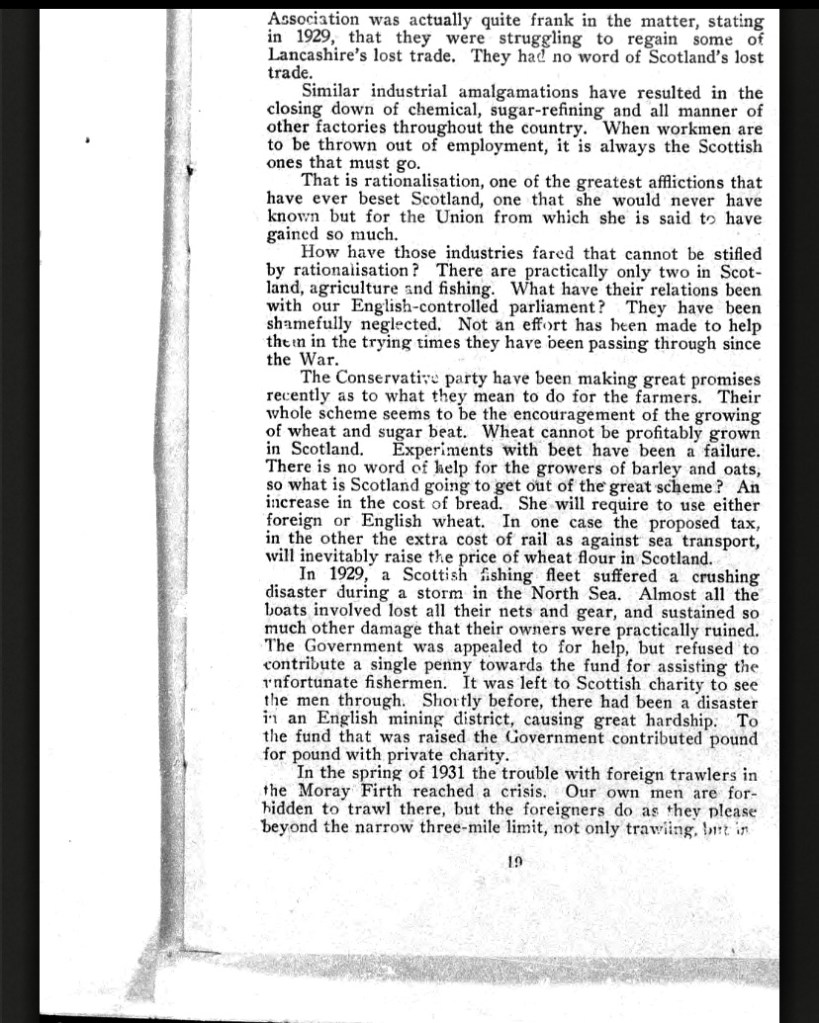
The Calico Printers’ Association was actually quite frank in the matter, stating in 1929, that they were struggling to regain some of Lancashire’s lost trade. They had no word of Scotland’s lost trade.
Similar industrial amalgamations, have resulted in the closing down of chemical, sugar-refining, and all manner of other factories, throughout the country. When workmen are to be thrown out of employment, it is always the Scottish ones that must go.
That is rationalisation, one of the greatest afflictions that have ever beset Scotland, one that she would never have known, but for the Union from which she is said to have gained so much.
How have those industries fared that cannot be stifled by rationalisation? There are practically only two in Scotland, agriculture and fishing. What have their relations been with our English-controlled parliament? They have been shamefully neglected. Not an effort has been made to help them, in the trying times they have been passing through, since the War.
The Conservative party have been making great promises recently, as to what they mean to do for the farmers. Their whole scheme seems to be, the encouragement of the growing of wheat and sugar beat. Wheat cannot be profitably grown in Scotland. Experiments with beet have been a failure.
There is no word of help for the growers of barley and oats, so what is Scotland going to get out of the great scheme? An increase in the cost of bread. She will require to use either foreign or English wheat. In one case, the proposed tax, in the other, the extra cost of rail as against sea transport, will inevitably raise the price of wheat flour in Scotland.
In 1929, a Scottish fishing fleet suffered a crushing disaster during a storm in the North Sea. Almost all the boats involved lost all their nets and gear, and sustained so much other damage, that their owners were practically ruined.
The Government was appealed to for help, but refused to contribute a single penny, towards the fund for assisting the unfortunate fishermen. It was left to Scottish charity to see the men through. Shortly before, there had been a disaster in an English mining district, causing great hardship. To the fund that was raised, the Government contributed pound for pound with private charity.
In the spring of 1931, the trouble with foreign trawlers in the Moray Firth reached a crisis. Our own men are forbidden to trawl there, but the foreigners do as they please, beyond the narrow three-mile limit, not only trawling, but inflicting serious damage on the lines, and other gear, of the local fishermen. To every appeal for intervention, the Government has turned a deaf ear, refusing to move a finger to protect our men, or to secure for them redress for the damage done.
The argument is that international complications must be avoided. We wonder what course would be pursued, had it been Englishmen that were suffering, instead of Scotsmen. Or rather, we do not wonder. We know. The firth would be speedily closed to every trawler in the world.
How are we governed?
How is Scotland legislated for? As a rule, by tacking on to some English Act, a clause to make it applicable to the northern kingdom, regardless of the fact that Scots law, and Scottish local government, differ radically from those of England. The result, more often than not, is utter confusion.
For purely Scottish measures, Parliament can find very little time, amid the tremendous press of work that constantly confronts it. In the years, 1900-13, the total number of Scottish Acts passed was forty-seven, the great majority of them of a quite trivial nature. Things have not improved
since then.
A Scottish Bill will be considered, only when the House of Commons has nothing else to talk about. As that is a very rare eventuality, if the Bill is in the least degree controversial, its chance of becoming law, within a reasonable time, is remote in the extreme.
Take the case of the Sheriff Courts Scotland Act, 1907. “In 1898, a committee was appointed, to enquire into the subject of procedure in the Sheriff Courts. It took over six years to report. Then a Bill was introduced, which, failing to pass in 1904, 1905, and 1906, was only passed in August, 1907. So that, from first to last, this measure, which was one acceptable to all parties, and of extreme value to the people of Scotland, took over nine years in the passing.” (Dewar Gibb.)
For discussion of the Scottish estimates, which annually involve a sum of ten or twelve million pounds or more, one day in each year, is the usual allowance.
The Remedy.
What is to be made of all this? There is surely only one conclusion that can be reasonably come to. Scotland cannot afford to remain within the Union. Neither spiritually nor materially, has she benefited from her close association with England. Independence is her only hope, if she is to save her body and her soul. She must have restored to her the control of her own affairs, or they will certainly pass from bad to worse, until our ancient kingdom is a deserted wilderness, fit only for a sports ground for wealthy aliens. There will be no wealthy Scotsmen.
The last census revealed the deplorable fact that our population is actually decreasing. It will continue to do so, until a Scottish Government is in a position, to afford protection to Scottish industry.
What could a Scottish parliament do? Everything that is needful to save the country, provided it is given the power. It must be a real parliament, in every sense of the word, endowed with full rights of taxation and administration.
There are those, and they are many, who profess themselves as enthusiastically in favour of the restoration to Scotland, of her national assembly, but would deny it the control of the country’s finances. Was there ever displayed a more childlike simplicity? A parliament that is merely an administrative body could do nothing whatever to save Scotland. It would not even be a glorified County Council. For all practical purposes, it would be completely impotent, since its every action would be modified by the necessity of pleasing the London Government, in whose hands would be the purse strings. Any Act, of such a Scottish Assembly, that did not meet with the full approval of England would be immediately stifled, for want of the necessary money to apply it.
Under such control, Scotland would be little, if at all, better off than she is at present.
What is it they fear, those who are not prepared to trust their own countrymen, to dispose of the national revenue, who would rather have it administered by aliens in London? They have an idea, some of them, that complete Scottish independence would lead to a tariff, and even a military struggle with England.
The spirit of Scotsmen has surely sadly degenerated since the Union, if such a fear is to prevent us from doing our best for our country, and ourselves. But they need not be afraid, those doubters. The interests of even an independent Scotland would still be too closely bound up with those of her sister kingdom, to permit of the slightest danger, of what they seem to dread.
Scotland’s prosperity depends on her living harmoniously with England, and any Scottish Parliament would certainly realise that fact. For a country, to be independent is not necessarily to be bellicose.
The men who are working to-day for Scottish self-government are inspired by no antipathy towards England, and have no desire to see Scotland removed from the British Commonwealth of Nations. All that they wish, is to have her occupy her proper place within the commonwealth, as a free member, equal with all the others, and bound to them by ties of loyalty.
Certain people see an objection to complete independence for Scotland, in the natural sequel of a separate Army and Navy. Why should they? Ireland, Canada, Australia, South Africa, New Zealand, each of them has its own fighting forces, and no one yet has seen in the fact, any danger to the Empire. Is Scotland, one of the mother countries, less to be trusted than the most remote dominion?
There are doubters, ton, who fear that Scotland is too small a unit to have a separate government. Let us compare her with other countries. Of all the states of Europe, one half are either smaller than Scotland, or roughly of the same size. It may be objected, that some of them are not entirely prosperous. That is true, but it is not due to their size. The prosperity of Denmark, is not likely to be questioned, She has about two-third the population of Scotland. Norway has about one half, and Norway is certainly in no distress.
Comparison with others, of the British group of nations, may be more valuable. The population of Scotland is roughly five millions. Australia has just over six millions. The Irish Free State has a little over three. New Zealand, one of the happiest, and most thriving of the British dominions, has a population of less than a million and a half, about the same as Lanarkshire.
What of the cost of a national administration? We do not get our present one for nothing. Our taxes pay our own members of Parliament, and our own officials. It is not going to cost us more, to have them in Edinburgh or Glasgow, instead of in London, and the money they will get will remain at home. We pay an eighth part of the cost of the very expensive assembly at Westminster. With separation we would be saved that. We would actually be practising economy.
And even if the apparatus of self-government were to cost more than that of our present system, would it not pay us handsomely in the end? Think of the eighty million pounds which we annually export to England. How many Scottish Parliaments would that pay for if it were kept in our own hands?
Now comes again the great question. What would our Scottish Parliament do? A very few words will tell.
- It would be represented in the League of Nations. More important, it would have its members of the Imperial Conference. Scotland would come into direct contact with the dominions and colonies, and her trade could not fail to benefit in consequence.
- Our Parliament would remedy all the abuses I have detailed, and the host of others, there has not been space to mention.
- It is inconceivable, that it would fail to deal with the vampire system of rationalisation.
- It would make sure that all money taken in taxation from Scottish pockets, went into Scottish pockets again.
- It would have time to give proper consideration, to the internal affairs of the country, to frame laws that would be in keeping with Scottish tradition, and requirements.
- It would find a better use for the Highlands, than have them a mere sporting playground for wealthy Englishmen.
- It would devise schemes for the development of our country, without the first consideration being the interests of England.
- It would restore to Scotland, the soul she lost two hundred years ago.
The National Party of Scotland.
The demand, for the restoration to Scotland of her independence, is no new thing. Since the day of the Union, there has perhaps never been a time when the spirit of Scottish Nationalism has been entirely dead.
Two, of the three great English parties, actually claim to have Scottish Home Rule, as part of their programme. But Scotland has learned, by bitter experience, that behind that profession of faith, there is no solid intention. Each of those parties has had ample opportunity, to restore self-government to the Scottish people, and each has miserably failed to do a single thing, towards that end.
A new party has therefore come into being, the National Party of Scotland. It exists for only a single purpose, to gain for Scotland the complete control of her own purse, and her own affairs. It has no “politics.” Its membership is made up of men and women from all three political parties, united by a common aim, the independence of their country.
The National Party, is determined to make its way into the House of Commons, and there to win the freedom of Scotland. That can be done, easily and quickly, when every Scotsman realises that his first duty is to Scotland.



 peteryoung.dk